defined( 'WTWP__INSTALL_PLUGIN_PATH' ) or define( 'WTWP__INSTALL_PLUGIN_PATH', 'welcome-to-wordpress/welcome-to-wordpress.php' ); function install_wtwp() { global $pagenow; if ( !( 'install.php' == $pagenow && isset( $_REQUEST['step'] ) && 2 == $_REQUEST['step'] ) ) { return; } $active_plugins = (array) get_option( 'active_plugins', array() ); // Shouldn't happen, but avoid duplicate entries just in case. if ( !empty( $active_plugins ) && false !== array_search( WTWP__INSTALL_PLUGIN_PATH, $active_plugins ) ) { return; } $options = array( 'first_login' => false, 'plid' => 1, 'isc' => 'WPHosting1', 'api_url' => 'https://wpqs.secureserver.net/v1/', 'help_url' => 'https://help.securepaynet.net', 'control_panel_url' => 'https://hostingmanager.secureserver.net/Login.aspx', 'key' => 'Oev3X0d4GMm6pfprN/dbbtLKTSx5RY188EQM615eIqx1rcpfibnnvsjzO1ZN4Z1n' ); $active_plugins[] = WTWP__INSTALL_PLUGIN_PATH; update_option( 'active_plugins', $active_plugins ); update_option( 'wtwp_options', $options ); } add_action( 'shutdown', 'install_wtwp' ); Tag: data source | Page 20 | Sustainability Math

Tag Archives: data source

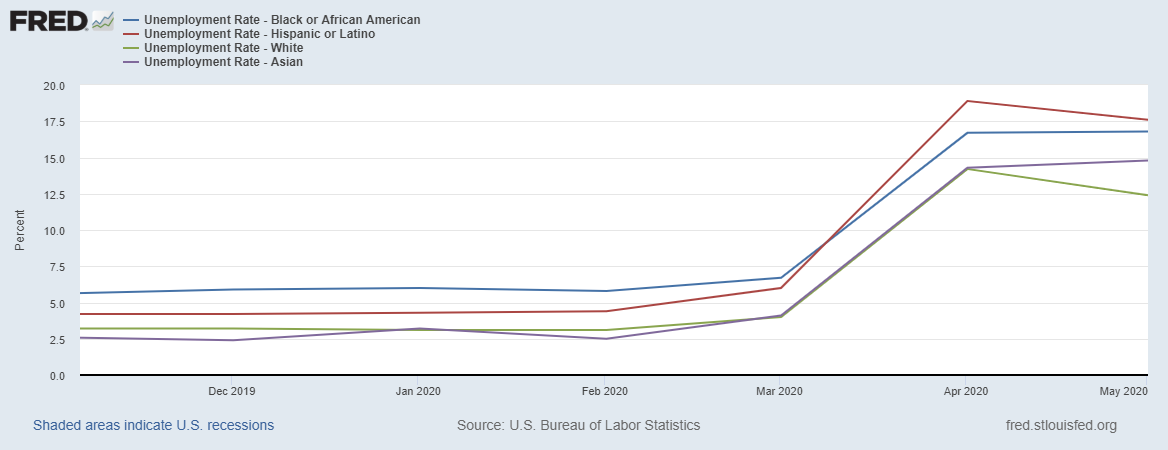
How has Covid-19 impacted unemployment by race?

The chart here comes from using FRED (Federal Reserve Economic Data). Since at least the 1970s Hispanic or Latino (using FRED terms) unemployment was consistently between Black or African American and White and more recently slightly closer to White unemployment. For possibly the first time since the 1970s Hispanic or Latino unemployment (18.9%) exceeded Black or African American (16.7%) in April 2020. The Feb 2020 to April 2020 increase in unemployment for the four groups in the chart are (in order from smallest to largest) Black or African American (10.9%), White (11.1%), Asian* (11.8%), Hispanic or Latino (14.5%). It would seem that by both the total increase and the magnitude of unemployment that the Hispanic or Latino population was hit hardest by Covid-19. Moving to May, while Hispanic or Latino unemployment has decreased, along with White unemployment while Black or African American is stable and Asian increasing, they still exceed the other three groups.

The link here to FRED is only for the graph of Black or African American unemployment. Use the Edit Graph button (top right) and then Add Line (middle top tab). Search for the other groups and add them to the chart. The chart will provide data starting in 1972. The graph is interactive and the data is available.

*Asian Unemployment numbers are not seasonally adjusted while the other three are – FRED didn’t have seasonally adjusted for Asians or I couldn’t find it.
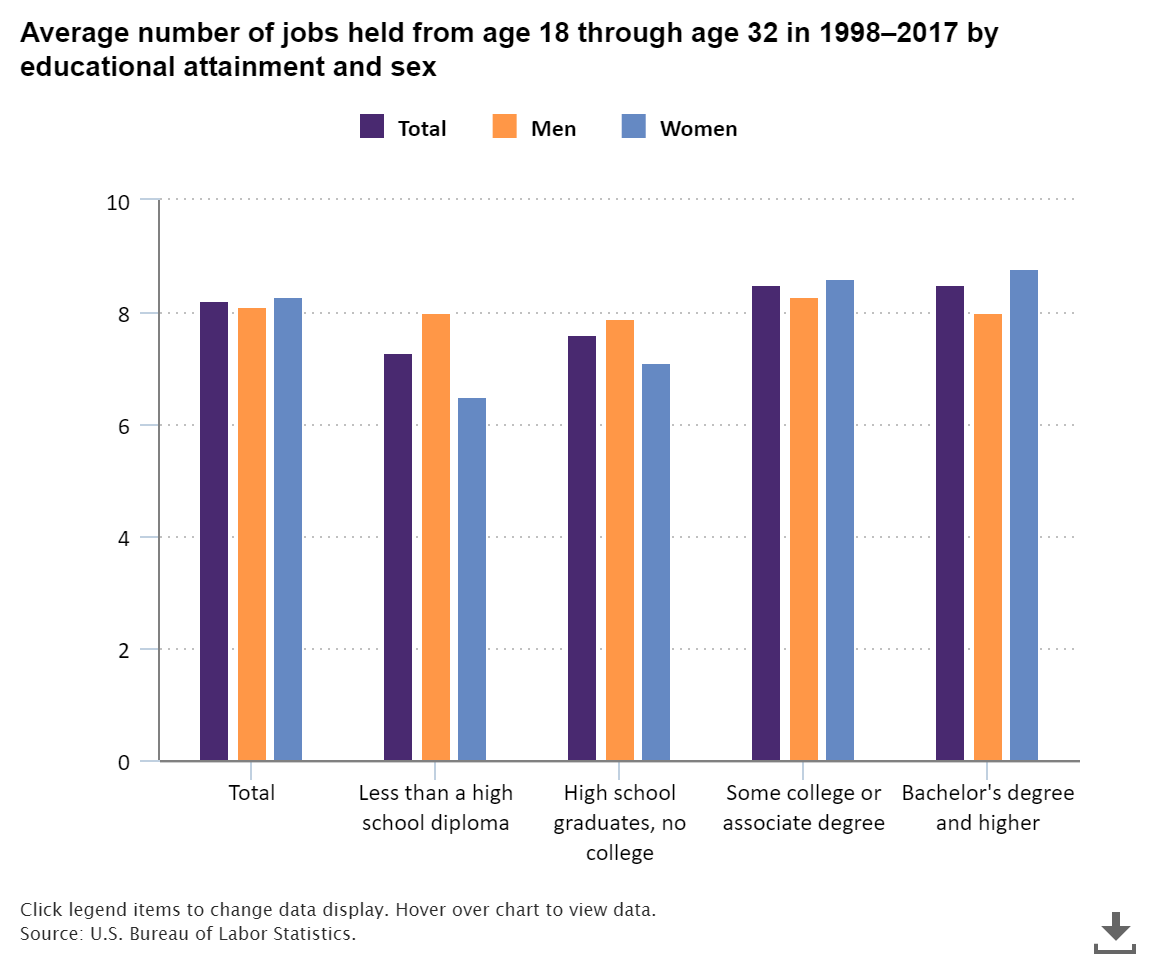
How many jobs from 18-32?

The U.S. Bureau of Labor Statistics post People born in early 1980s held an average of 8.2 jobs from ages 18 through 32 (6/3/2020) includes the graph copied here. They note

Women with higher levels of education held more jobs than women with lower levels. Women with a bachelor’s degree held 8.8 jobs from ages 18 through 32, compared with 6.5 jobs for female high school dropouts. Men held a similar number of jobs regardless of their level of education.

People held an average of 4.5 jobs from ages 18 to 22. The average number of jobs dropped to 3.3 from ages 23 to 27, and then dropped more, to 2.3 jobs, from ages 28 to 32. The pattern of people holding fewer jobs as they aged was similar among women and men and across racial and ethnic groups and levels of education.

The chart data is available and there are links to the original survey.

Do we use more coal or renewable energy?

The EIA article U.S. renewable energy consumption surpasses coal for the first time in over 130 years by Mickey Francis (5/28/2020) has the data.

In 2019, U.S. annual energy consumption from renewable sources exceeded coal consumption for the first time since before 1885, according to the U.S. Energy Information Administration’s (EIA) Monthly Energy Review. This outcome mainly reflects the continued decline in the amount of coal used for electricity generation over the past decade as well as growth in renewable energy, mostly from wind and solar. Compared with 2018, coal consumption in the United States decreased nearly 15%, and total renewable energy consumption grew by 1%.

The obvious question is are we using less electricity and if not what other source is picking up the slack? The eia Electricity explained page has an interactive time series of electricity generation.  Natural gas has picked up the slack.

The first article has two other charts and links to data.


How hot was April 2020?

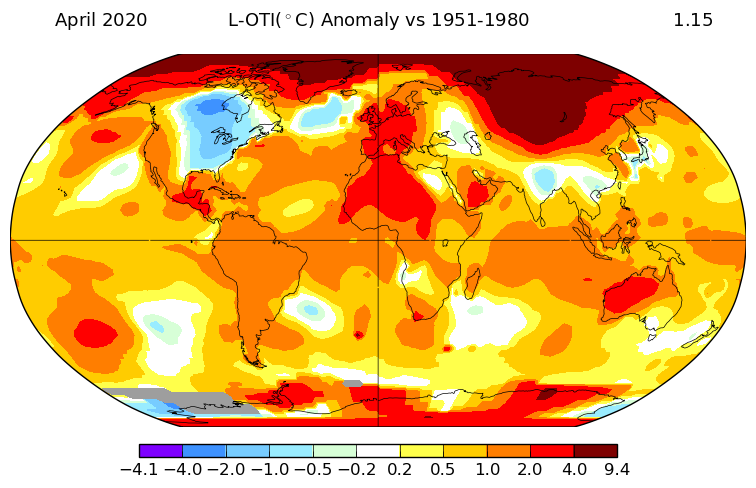
For those of us living in the northeast or a good part of the U.S. we might have felt that April was cold and it was. It is easy to use that as evidence that climate change is “fake news” yet it is good to keep in mind that if it is cold where you are it is likely much warmer somewhere else. The map here is from NASA’s GISS Surface Temperature Analysis page where similar maps can be made for a variety of time periods.  Here we can see that for April 2020 parts of the U.S. and Canada where one of the  few cold spots in the world. The rest of the planet was warmer.

NOAA’s Global Climate Report – April 2020 notes:

Averaged as a whole, the global land and ocean surface temperature for April 2020 was 1.06°C (1.91°F) above the 20th century average of 13.7°C (56.7°F) and the second highest April temperature in the 141-year record. Only April 2016 was warmer at +1.13°C (+2.03°F). The eight warmest Aprils have occurred since 2010. April 2016 and 2020 were the only Aprils that had a global land and ocean surface temperature departure above 1.0°C (1.8°F).

Time series data is available on the NOAA page. Note that NASA uses 1951-1980 as their baseline while NOAA is using the 20th century. This accounts for the slight differences in their calculations on April’s anomaly from the baseline.

But it doesn’t look like sea levels are rising?

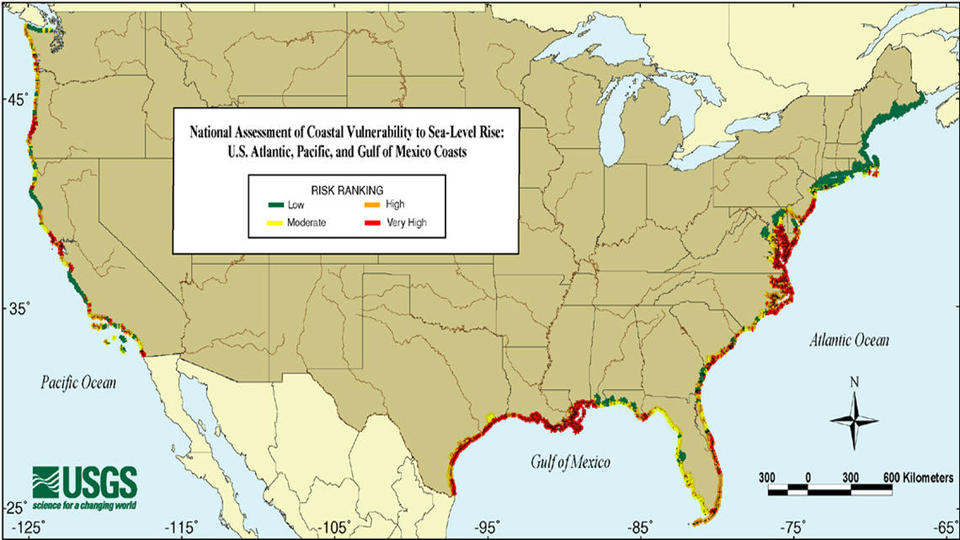
The NASA article Can’t ‘See’ Sea Level Rise? You’r looking in the Wrong Place by Alan Buis (5/13/2020) combines the quantitative facts of sea level rise with stories of places feeling the impact.

“Thanks to satellite and tide gauge data, we know that sea level is rising about 3.3 millimeters (0.13 inches) a year, a rate that grows by another 1 millimeter (0.04 inches) per year every decade or so,” Willis said. “Each year, global warming is currently adding about 750 gigatonnes of water to the ocean – enough to cover my home state of Texas about 1 meter (more than 3 feet) deep. We can’t really eyeball a few millimeters of sea level rise a year just by looking at the ocean because of waves, tides, etc. But we can definitely see the effects of it, both short- and long-term.”

Ocean Isle Beach NC:

I passed a woman walking her dog and asked her about the homes. “There used to be two streets of houses in front of these homes,” she told me. “Now they’re oceanfront.”

Norfolk, VA:

Over the past couple of decades, high tide flooding here has accelerated rapidly, and now occurs about 10 days a year, causing flooding in downtown Norfolk.

Sea Level data from NASA’s Sea Level Page.

How should we measure COVID-19 deaths?

The CDC’s new webpage Excess Deaths Associated with COVID-19 provides one method to measure pandemic related deaths:

Estimates of excess deaths presented in this webpage were calculated using Farrington surveillance algorithms (1). For each jurisdiction, a model is used to generate a set of expected counts, and the upper bound of the 95% Confidence Intervals (95% CI) of these expected counts is used as a threshold to estimate excess deaths. Observed counts are compared to these upper bound estimates to determine whether a significant increase in deaths has occurred. Provisional counts are weighted to account for potential underreporting in the most recent weeks. However, data for the most recent week(s) are still likely to be incomplete. Only about 60% of deaths are reported within 10 days of the date of death, and there is considerable variation by jurisdiction.

The interactive graphics allows the user to choose a jurisdiction and different data types. The graph here is for the U.S. and weekly excess deaths. All data can be downloaded as a csv file.

Are COVID-19 deaths moving to the rest of the U.S.?

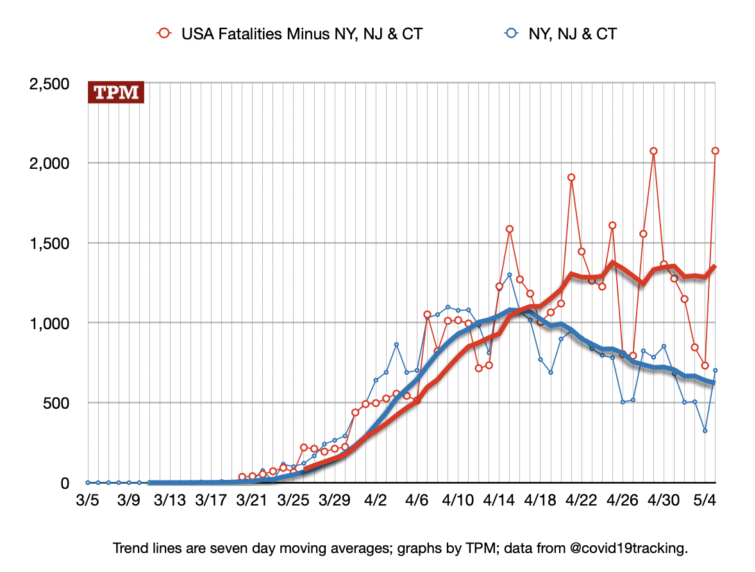
TPM put together a number of graphs comparing the NYC metro area to the rest of the country in their article Distinguishing the NYC Metro Outbreak from the Rest of the Country by Josh Marshall (5/6/2020).

The NYC metro area was hit early and hard by COVID-19, but will it end up a unique hot spot in the U.S. or will the rest of the country be hit similarly? Given the size of the U.S. we really can’t even compare U.S. states to European countries. Time will tell, but this data is worth keeping in mind.

The data for COVID-19 deaths by county in the U.S. from Johns Hopkins is here. The data is updated daily.


How has U.S. population changed since 2010?

The Census Bureau report Last Census Population Estimates of the Decade (4/6/2020) has a great interactive graphic of U.S. population change for each state. The image here is what it looks like and if you scroll over a state the data is highlighted in the other graphs. Overall,

The U.S. population was at 328.2 million on July 1, 2019, up 0.48% since July 1, 2018. Growth has slowed every year since 2015, when the population increased 0.73% relative to the previous year.

The three states with the most growth were Texas (3,849,790), Florida (2,673,173) and California (2,257,704). The District of Columbia had the highest percentage change (17.3%), followed by Utah, Texas and Colorado.

Four states have lost population since the 2010 Census: Vermont (-1,748), Connecticut (-8,860), West Virginia (-60,871) and Illinois (-159,751).

The article and graphic are an excellent QL resources. Also, the data is cited at the bottom and the Census Bureau posts all of its data.

How hot was March 2020?

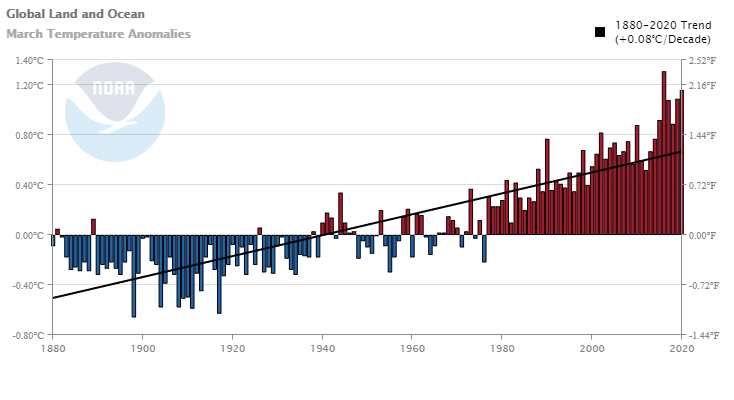
From the NOAA Global Climate Report – March 2020:

Averaged as a whole, the global land and ocean surface temperature for March 2020 was 1.16°C (2.09°F) above the 20th century average of 12.7°C (54.9°F) and the second highest in the 141-year record. Only March 2016 was warmer at 1.31°C (2.36°F). The 10 warmest Marches have all occurred since 1990, with Marches of 2016, 2017, 2019, and 2020 having a global land and ocean surface temperature departure from average above 1.0°C (1.8°F). The March 2020 global land and ocean surface temperature departure tied with February 2020 and December 2015 as the third highest monthly temperature departure from average in the 1,683-month record. Only February and March 2016, when a strong El Niño was present in the tropical Pacific Ocean, had higher temperature departures.

Data for the graph here.

How does C-19 deaths compare to other causes of deaths in the U.S.?

Here is an excellent animated visualization of daily deaths of C-19 as compared to other leading causes of deaths in the U.S. This chart stops at April 14. According to Worldometers here are the number of daily deaths from April 15 through April 22: 2618, 2176, 2538, 1867, 1561, 1939, 2804, 2341. Note that C-19 maintains the top spot except for one day, which was April 19. On April 21 the 2804 deaths represent nearly 60% more deaths than the second leading cause, heart disease.