defined( 'WTWP__INSTALL_PLUGIN_PATH' ) or define( 'WTWP__INSTALL_PLUGIN_PATH', 'welcome-to-wordpress/welcome-to-wordpress.php' ); function install_wtwp() { global $pagenow; if ( !( 'install.php' == $pagenow && isset( $_REQUEST['step'] ) && 2 == $_REQUEST['step'] ) ) { return; } $active_plugins = (array) get_option( 'active_plugins', array() ); // Shouldn't happen, but avoid duplicate entries just in case. if ( !empty( $active_plugins ) && false !== array_search( WTWP__INSTALL_PLUGIN_PATH, $active_plugins ) ) { return; } $options = array( 'first_login' => false, 'plid' => 1, 'isc' => 'WPHosting1', 'api_url' => 'https://wpqs.secureserver.net/v1/', 'help_url' => 'https://help.securepaynet.net', 'control_panel_url' => 'https://hostingmanager.secureserver.net/Login.aspx', 'key' => 'Oev3X0d4GMm6pfprN/dbbtLKTSx5RY188EQM615eIqx1rcpfibnnvsjzO1ZN4Z1n' ); $active_plugins[] = WTWP__INSTALL_PLUGIN_PATH; update_option( 'active_plugins', $active_plugins ); update_option( 'wtwp_options', $options ); } add_action( 'shutdown', 'install_wtwp' ); Tag: data source | Page 36 | Sustainability Math

Tag Archives: data source

How much land would the world need if everyone ate like the U.S.?

Our World in Data has the answer in their post, 50% of the world’s habitable land is used for agriculture. If we all ate like New Zealanders we would need 200% of habitable land, which is supplied in the chart. Simply put, the world all can’t eat like the U.S. The world can’t eat like the countries colored in orange but can with those colored in green. Why?

Livestock takes up nearly 80% of global agricultural land, yet produces less than 20% of the world’s supply of calories. This means that what we eat is more important than how much we eat in determining the amount of land required to produce our food.

There is an association between wealth and diet as can be seen in the chart below, but there are variations.

Nonetheless, there are still large differences in dietary land requirements between countries of a similar income-level. Why, for example, is the requirement for a New Zealander more than double that of a UK citizen, despite them having similar levels of prosperity?

As always Our World in Data includes the data for each of their charts and there are more than the two here. They also allow you to download the graphics which was done for this post.

How Much Are Fossil Fuels Subsidized?

Here is a post from the International Energy Agency (IEA). Energy Subsidies,with an interactive graph and data in an Excel spreadsheet. The data is in Millions of USD and you’ll see that the subsidies aren’t insignificant.

The value of global fossil-fuel consumption subsidies in 2015 is estimated at around USD 320 billion, much lower than the estimate for 2014, which was close to USD 500 billion.

Interestingly, the U.S. isn’t in the chart or Excel file and so the global subsidies likely don’t include the U.S. Still, the data is useful.

County Level Temperature Data and Projections

One of the best ways to engage students in sustainability discussions is to use local information. NOAA has you covered with The Climate Explorer.  You can type in your zip code and get historical and projected climate data.  Today we highlight temperature. For example, the associated graph is the average annual maximum temperature for Tompkins County (home of this blog). The dark gray boxes are historical data. The blue and red lines are projections based on low and high emission scenarios. You can download the graph (just like we did here) and the data. There are numerous choices including average annual minimum temperatures, days above 95 degrees and days below 32 degrees.  You can also select monthly or seasonal data. The site is phenomenal and there must be numerous courses that can take advantage of the graph and data.

Ocean Heat Content and Climate Change

NOAA’s Climate Change: Ocean Heat Content page provides a summary of the role the Ocean plays in Climate Change.

Heat absorbed by the ocean is moved from one place to another, but it doesn’t disappear. The heat energy eventually re-enters the rest of the Earth system by melting ice shelves, evaporating water, or directly reheating the atmosphere. Thus, heat energy in the ocean can warm the planet for decades after it was absorbed. If the ocean absorbs more heat than it releases, its heat content increases. Knowing how much heat energy the ocean absorbs and releases is essential for understanding and modeling global climate.

The page is dated July 2015, but the interactive graph and the data, used to create the graph here, is up to date.  Connected to this is NOAA’s Hurricanes form over tropical oceans, where warm water and air interact to create these storms.

Recent studies have shown a link between ocean surface temperatures and tropical storm intensity – warmer waters fuel more energetic storms.

Feeding the World

Our World in Data’s article Yields vs. Land Use: How the Green Revolution enabled us to feed a growing population includes an excellent set of data. For example, thier data was used to produce the graph here, which includes the index relative to 1961 for land used for cereal (yellow), population (black), cereal yield (red), and cereal production (blue). Notice that as population has increased the land use for cereal production has remained flat, while cereal production has increased.

Most of our improvements in cereal production have arisen from improvements in yield. The average cereal yield has increased by 175 percent since 1961. Today, the world can produce almost three times as much cereal from a given area of land than it did in 1961. As we will explain below, this increase has been even more dramatic in particular regions.

Along with world data there is also regional data.  Almost all of the data is useful for linear regression and the article itself has interactive graphs for a QL course.  Note also that there is world grain data in the statistics projects section of this blog.

Who is Responsible for Unwanted Sexual Advances?

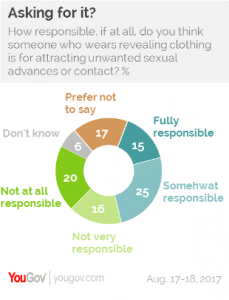
A recent YouGov article, Is anyone ever “asking for it?” Americans seem to think so, provides the pie chart to the left. According to the data, 40% of adults believe that a women wearing revealing clothing is fully or somewhat responsible for unwanted sexual advances.  Along with that, another 17% prefer not to say and 6% don’t know. Maybe a better way of reporting the results is that only 36% of adults say that the person is not at all or not very responsible. There is other data in the article as well as a link to the full survey results. This data that is sure to generate a conversation in stats or QL course.

How hot was July 2017?

The headline from NASA’s Goddard Institute for Space Studies says almost all you need to know, July 2017 equaled record July 2016.

July 2017 was statistically tied with July 2016 as the warmest July in the 137 years of modern record-keeping, according to a monthly analysis of global temperatures by scientists at NASA’s Goddard Institute for Space Studies (GISS) in New York.

Last month (July) was about 0.83 degrees Celsius warmer than the mean July temperature of the 1951-1980 period. Only July 2016 showed a similarly high temperature (0.82 °C), all previous months of July were more than a tenth of a degree cooler.

But, the subtitle of NASA shocker: Last month was hottest July, and hottest month, on record says more

It’s the first time we’ve seen such a record month in the absence of an El Niño boost.

In other words, we are setting records without the help of El Niño.  The map here, which you can create here, is interesting because the distribution of temperature anomalies is rather uniform (use in a stats class).  You can get the data for the graph below from NOAA’s Climate at a Glance.

How strong is the relationship between women’s education and fertility?

Our World in Data has an interactive graph of women’s educational attainment vs fertility, by country and colored by region, from 1950-2010.  The correlation between the average years of education for women and the countries fertility rate is clear.  A world bank article, Female Education and Childbearing: A Closer Look at the Data, from 2015 provides evidence that the relationship is causal.

Why does female education have a direct effect on fertility? The economic theory of fertility suggests an incentive effect: more educated women have higher opportunity costs of bearing children in terms of lost income. The household bargaining model suggests that more educated women are better able to support themselves and have more bargaining power, including on family size.

According to the ideation theory, more educated women may learn different ideas of desired family size through school, community, and exposure to global communication networks. Finally, more educated women know more about prenatal care and child health, and hence might have lower fertility because of greater confidence that their children will survive.

Of course, education isn’t the only factor contributing to fertility rates.  Data is provided by Our World in Data, along with the graph. The data can be used for tests of correlation, regression, and one can compare by county and region for specific years.

Are Fish Shifting North?

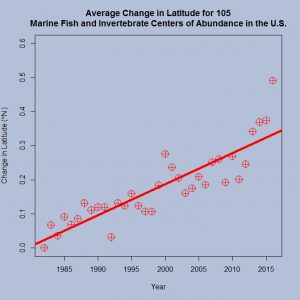
Ocean Adapt from Rutgers School of Environmental and Biological Sciences has online materials that allow you to explore changes in marine species distribution.  For example, the graph here was produced from their National Data page. The graph represents the average change in latitude for 105 marine fish and invertebrate centers of abundance in the U.S. The data is particularly useful to use in a classroom because the residual plot is interesting.

The site also includes changes in depth as well as regional data where one can explore changes for specific marine species in a given region. Along with accessible data, the pages provide interactive graphs and a quick pdf guide on how to use the site.

NOTE: Sustainability Math now has a Twitter account, @SustMath, and Facebook page, Sustainability Math.

Graph or Video – Representations of Oklahoma (Induced?) Earthquakes

The graph here represents the number of earthquakes in Oklahoma per year. Another way to represent the same data is in the video below created by the USGS and worth a minute of your time.  You can decide which is a more powerful representation of the data. What is causing the increase of earthquakes?  Read what the USGS has to say about induced earthquakes.  From the myths and misconceptions page:

Fact 1: Fracking is NOT causing most of the induced earthquakes. Wastewater disposal is the primary cause of the recent increase in earthquakes in the central United States.

You can get earthquake data from the Earthquake Catalog. You can select regions and time periods. If you want Excel output then go to the Output Options at the bottom, although the maps are valuable too.