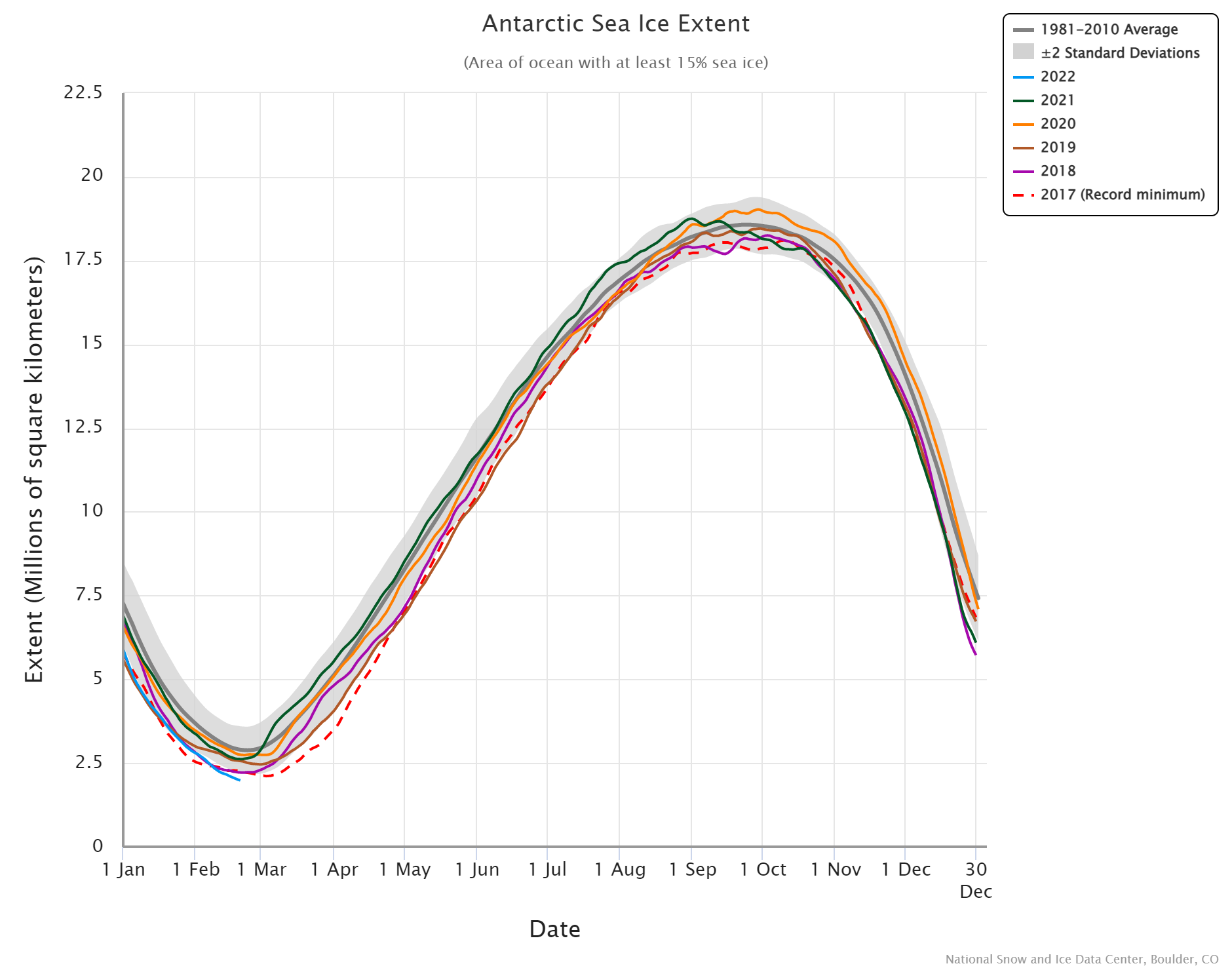
 The Antarctic has broken the record low for sea ice extent and doesn’t appear to be done. The chart here is from the National Snow and Ice Data Center’s Charctic Interactive Sea Ice Graph page. Data is available from the Sea Ice Data and Analysis Tools page.
How hot was Jan 2022?
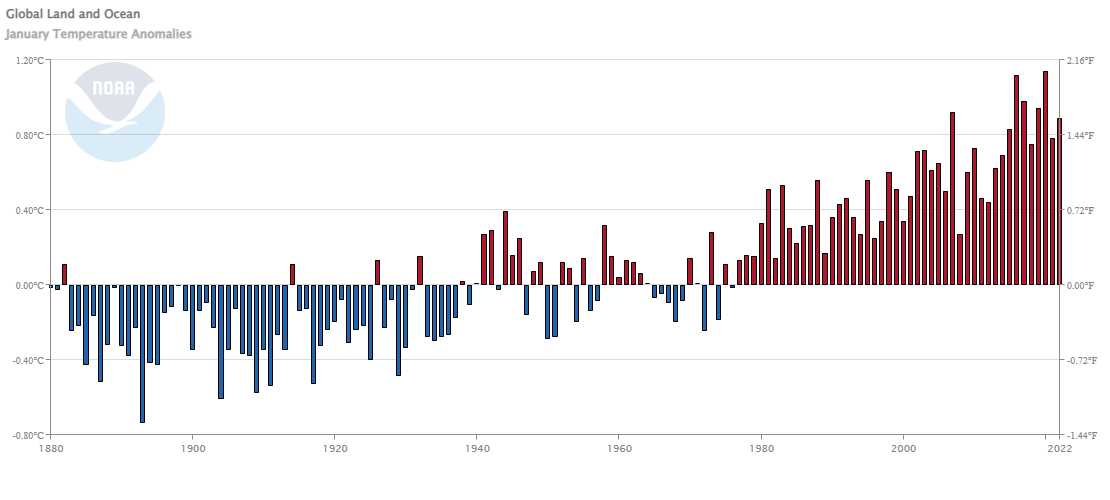 From NOAA’s Global Climate Report – January 2022:
The global surface temperature for January 2022 was 0.89°C (1.60°F) above the 20th century average and the sixth highest for January since global records began in 1880. The last eight Januarys (2015–2022) rank among the 10 warmest Januarys on record.
Similar to 2021, the year 2022 began with an episode of a La Niña in the tropical Pacific Ocean. The El Niño-Southern Oscillation (ENSO) can affect global temperatures. La Niña tends to cool global temperatures slightly, while El Niño tends to boost global temperatures. With a slightly cool start to the year, there is only a 10% chance of 2022 ending as the warmest year on record. However, there is over 99% chance of the year ranking among the 10 warmest years on record.
Time series data available at the top of the page.
How do vaccination rate differ?
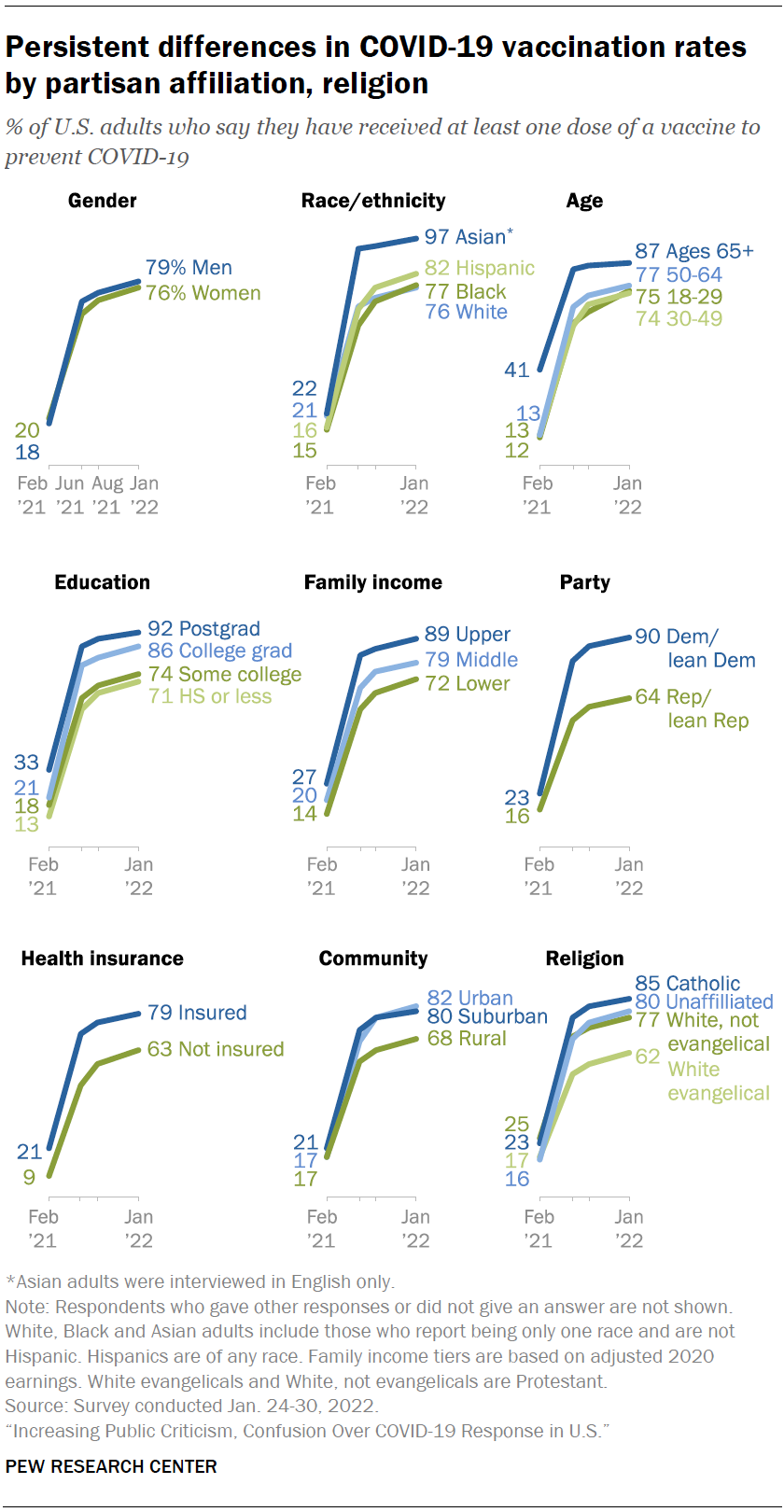
The Pew article Increasing Public Criticism, Confusion Over COVID-19 Response in U.S. by Alec Tyson and Cary Funk (2/9/2022) has the graph copied here, which seems unrelated to the title but is interesting. I’ll leave you to decide what is surprising and what isn’t. Further:
Some demographic differences in vaccination status are more pronounced within one partisan group than another. For instance, 80% of Republicans ages 65 and older say they have received a COVID-19 vaccine, compared with far fewer Republicans 18 to 29 (52%). There is a much more modest gap between the shares of Democrats 65 and older and those 18 to 29 who say they’ve received a vaccine (94% vs. 88%). See the Appendix for more details on vaccination status within partisan groups.
This all seems like good data for statistical tests. There are more graphs, a methodology section, and more data.
How hot are the oceans?
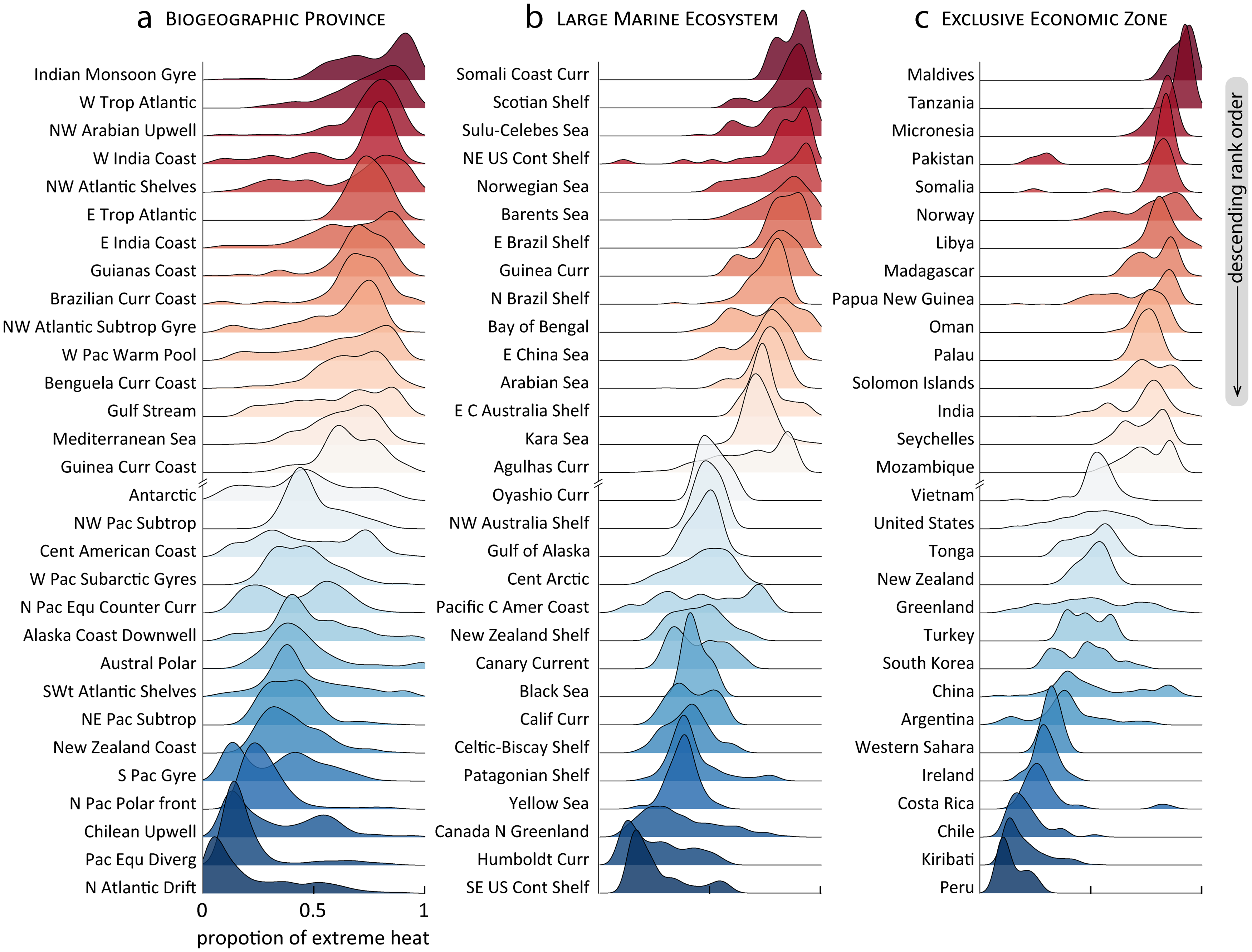
The abstract from The recent normalization of historical marine heat extremes by Kisei R. Tanaka and Kyle S. Van Houtan (2/1/2022) in PLOS Climate:
Climate change exposes marine ecosystems to extreme conditions with increasing frequency. Capitalizing on the global reconstruction of sea surface temperature (SST) records from 1870-present, we present a centennial-scale index of extreme marine heat within a coherent and comparable statistical framework. A spatially (1° × 1°) and temporally (monthly) resolved index of the normalized historical extreme marine heat events was expressed as a fraction of a year that exceeds a locally determined, monthly varying 98th percentile of SST gradients derived from the first 50 years of climatological records (1870–1919). For the year 2019, our index reports that 57% of the global ocean surface recorded extreme heat, which was comparatively rare (approximately 2%) during the period of the second industrial revolution. Significant increases in the extent of extreme marine events over the past century resulted in many local climates to have shifted out of their historical SST bounds across many economically and ecologically important marine regions. For the global ocean, 2014 was the first year to exceed the 50% threshold of extreme heat thereby becoming “normal”, with the South Atlantic (1998) and Indian (2007) basins crossing this barrier earlier. By focusing on heat extremes, we provide an alternative framework that may help better contextualize the dramatic changes currently occurring in marine systems.
The paper includes a link to the data (so you can reproduce the cool ridge plot here) and there are three other graph.
How many billion dollar disasters in 2021?
 The NOAA Billion-Dollar Weather and Climate Disasters page keeps track of these events.
During 2021, there were 20 separate billion-dollar weather and climate disaster events across the United States. The total cost from these events of 2021 was $145.0 billion and is the third most costly year on record, behind 2017 and 2005. The total costs for the last five years ($742.1 billion) is more than one-third of the disaster cost total of the last 42-years (1980-2021), which exceeds $2.155 trillion (inflation-adjusted to 2021 dollars). This reflects a 5-year cost average of nearly $148.4 billion/year — a new record — as shown above by the black line.
The chart copied here is interactive on their page and has lots of information. You can also select a state or region and get a similar chart. Data can be downloaded.
Who’s been vaccinated?
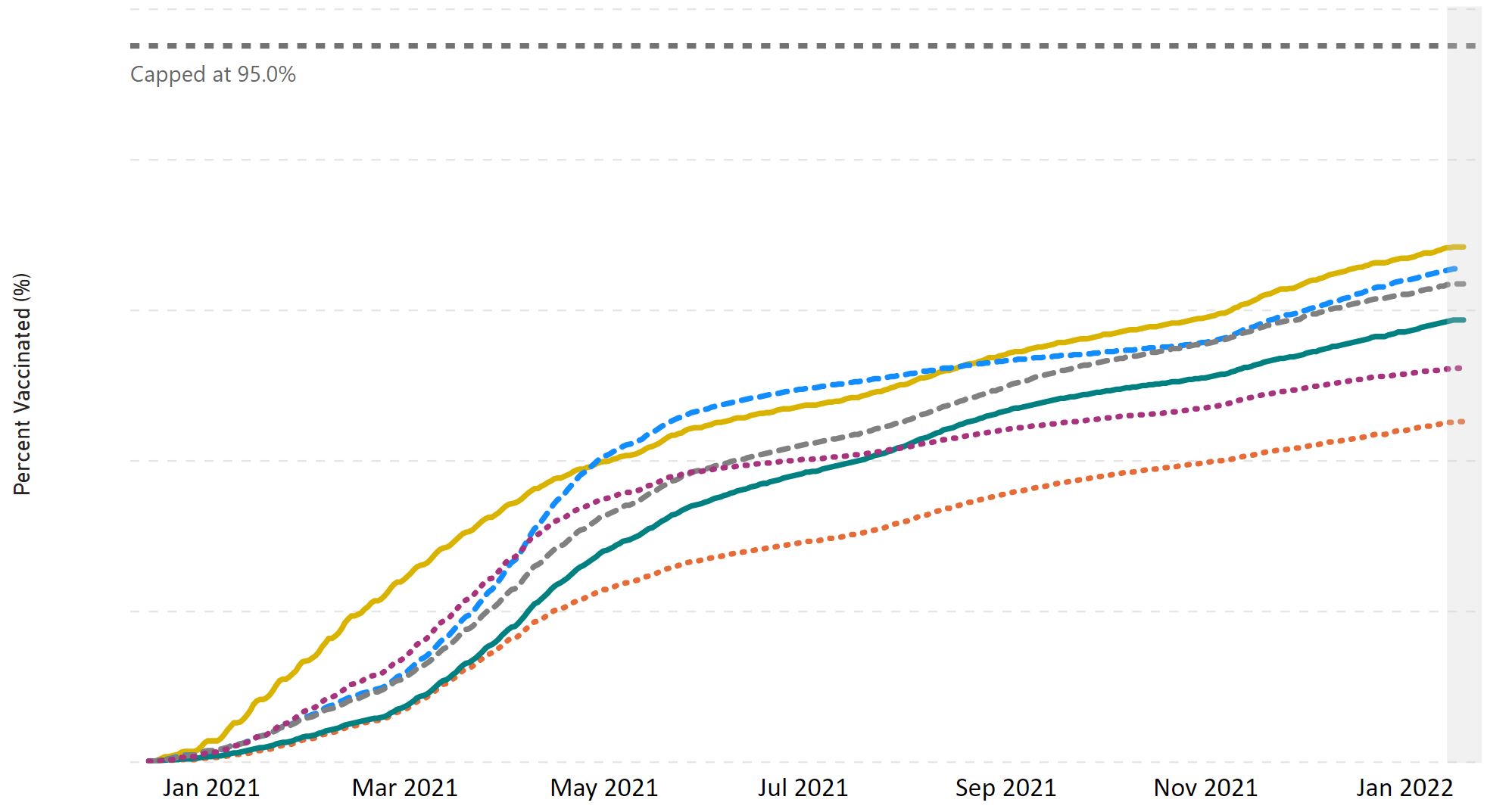
If you want data on vaccinated status the CDC page Demographic Trends of People Receiving COVID-19 Vaccination in the United States is a place to go. For example, one graph from their page is copied here and includes at least one dose by Race/Ethnicity. The graph are designed for interactivity so you don’t see categories and percent without placing a mouse pointer over the graph. Curious about the categories, then click the link.
What is interesting is they have administered data, the graph here, but also results from survey data. They aren’t the same. This seems like something to discuss or study in a stats or QL course. There are multiple interactive graphs and plenty of quantitative information.
How hot was 2021, ENSO version?

From NOAA’s Global Climate Report – Annual 2021:
The year 2021 began with an episode of cold phase El Niño Southern Oscillation (ENSO) episode, also known as La Niña, across the central and eastern tropical Pacific Ocean, which had developed in August 2020. As seen in the graph below, ENSO can have an effect on global temperatures. La Niña episodes tend to cool global temperatures slightly, while the warm phase ENSO (also known as El Niño) tends to boost global temperatures. Although the monthly global temperatures were above average throughout the year, February 2021 was the coldest month of 2021 for the globe. The global temperature departure for February 2021 was +0.64°C (+1.15°F) — the coolest February since 2014. However, after the month of February, temperatures were at 0.80°C (1.44°F) or higher for the remaining months of 2021.
The net result:
The year culminated as the sixth warmest year on record for the globe with a temperature that was 0.84°C (1.51°F) above the 20th century average. The years 2013–2021 all rank among the ten warmest years on record.
Time series data available at the top. ENSO status data must be somewhere but there doesn’t appear to be a link; just the graph.
How hot was Dec 2021?
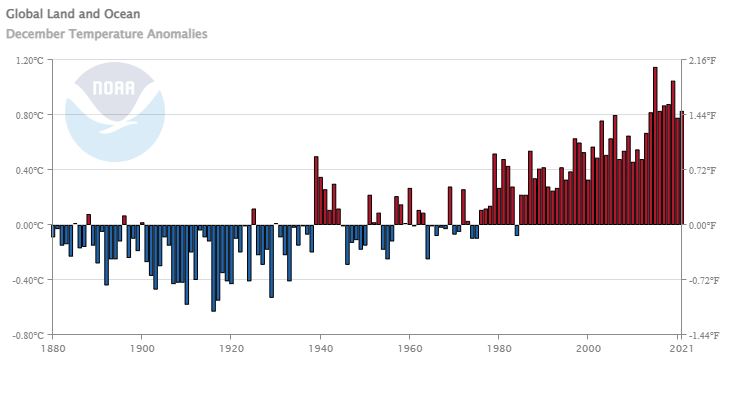 From NOAA’s Global Climate Report – December 2021:
The December 2021 global surface temperature tied with 2016 as the fifth highest in the 142-year record at 0.83°C (1.49°F) above the 20th century average. Eight of the 10 warmest Decembers have occurred since 2014. December 2021 also marked the 37th consecutive December and the 444th consecutive month with temperatures, at least nominally, above the 20th century average.
Regionally?
During the month of December, the most notable warm temperature departures were present across much of the contiguous U.S. and across parts of eastern Canada, northern Mexico, and southern Asia, where temperatures were at least 2.5°C (4.5°F) above average. Record-warm December temperatures were present across a large area of the southwestern Pacific Ocean and small areas across North America, South America, Africa, Asia, and the Atlantic Ocean. Meanwhile, the most notable cool temperatures were observed across the western half of Canada and across parts of Scandinavia and northern Russia. However, no land or ocean areas had a record-cold December temperature.
Time series data is available at the top of the page.
Has Lake Mead Risen?

Despite some drought relief out west (see U.S. Drought Monitor , still drought but generally less severe) Lake Mead has made little improvement. The graph here is from the data on the Lake Mead at Hoover Dam, End of Month Elevation (feet) page by the Bureau of Reclamation.
The Sept Lake Mead post and the July Lake Mead post, which has a link to the R code for the graph.
How much has the Ocean warmed?
 Climate.gov provides an updated on ocean heat in the Climate Change: Ocean Heat Content article by Luann Dahlman and Rebecca Lindsey (updated 10/12/2021):
Averaged over Earth’s surface, the 1993–2020 heat-gain rates were 0.37–0.41 Watts per square meter for depths from 0–700 meters (down to 0.4 miles), depending on which research group’s analysis you consult. Meanwhile, heat gain rates were 0.15–0.31 Watts per square meter for depths of 700–2,000 meters (0.4–1.2 miles). For depths between 2000–6000 meters (1.2–3.7 miles), the estimated increase was 0.06 Watts per square meter for the period from June 1992 to July 2011. According to the State of the Climate 2019 report, “Summing the three layers (despite their slightly different time periods as given above), the full-depth ocean heat gain rate ranges from 0.58 to 0.78 W m-2 applied to Earth’s entire surface.”
The article has helpful short summaries on how heat moves and measuring ocean heat. They link to Global Ocean Heat and Salt Content: Seasonal, Yearly, and Pentadal Fields for the data.