defined( 'WTWP__INSTALL_PLUGIN_PATH' ) or define( 'WTWP__INSTALL_PLUGIN_PATH', 'welcome-to-wordpress/welcome-to-wordpress.php' ); function install_wtwp() { global $pagenow; if ( !( 'install.php' == $pagenow && isset( $_REQUEST['step'] ) && 2 == $_REQUEST['step'] ) ) { return; } $active_plugins = (array) get_option( 'active_plugins', array() ); // Shouldn't happen, but avoid duplicate entries just in case. if ( !empty( $active_plugins ) && false !== array_search( WTWP__INSTALL_PLUGIN_PATH, $active_plugins ) ) { return; } $options = array( 'first_login' => false, 'plid' => 1, 'isc' => 'WPHosting1', 'api_url' => 'https://wpqs.secureserver.net/v1/', 'help_url' => 'https://help.securepaynet.net', 'control_panel_url' => 'https://hostingmanager.secureserver.net/Login.aspx', 'key' => 'Oev3X0d4GMm6pfprN/dbbtLKTSx5RY188EQM615eIqx1rcpfibnnvsjzO1ZN4Z1n' ); $active_plugins[] = WTWP__INSTALL_PLUGIN_PATH; update_option( 'active_plugins', $active_plugins ); update_option( 'wtwp_options', $options ); } add_action( 'shutdown', 'install_wtwp' ); Tag: data source | Page 4 | Sustainability Math

Tag Archives: data source

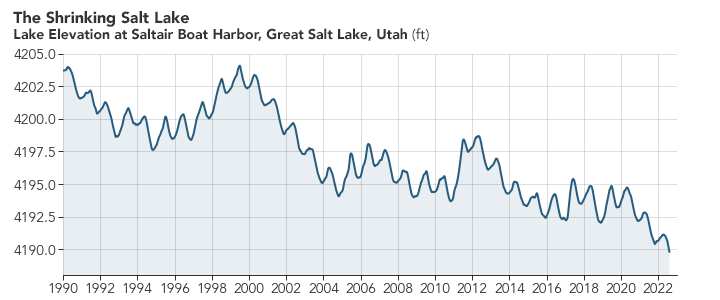
What is the status of the Great Salt Lake?

You may be seeing articles about the Great Salt Lake in the news and how it drying up is an environmental problem.  NASA Earth Observatory had a great article last summer, The Great Shrinking Lake, with maps and data about the loss of water.

Though water levels in the Great Salt Lake can fluctuate by year, they have generally been declining for decades. At the lake’s highest recorded level in 1986, mean water elevation reached as high as 4,211.6 feet (1,283.7 meters). Since 1986, the lake has dropped about 22 feet, hitting a new record low on July 3, 2022. By August 10, 2022, water levels had dropped slightly more—to 4,189.6 feet (1,276.9 meters).

Now 20 feet may not seem like a lot, but click the NASA link and take a look at the then and now map with the slider. The surface area of the lake had decreased dramatically. The NASA post also has a well-done animated graph. If you want data about the Great Salt Like go to Hydroshare page Collection of Great Salt Lake Data. Daily updated lake elevation and drought maps can be found at the Great Salt Lake Water Level page.

Has Lake Mead improved?

If you have been following my Lake Mead post you might be  curious if the rain in the west has improved the situation. Well, you probably looked at the graph by now and realized that the levels haven’t risen much. Based on the graph it seems that Dec to Jan is typically the biggest jump in levels with the max occurring each year between Jan and March. I’ll check back once the March data is in, but this certainly seems like a problem that is only getting worse.

The graph here is from the data on the Lake Mead at Hoover Dam, End of Month Elevation (feet) page by the Bureau of Reclamation. The Sept Lake Mead post.

How have commodity prices changes in the last month?

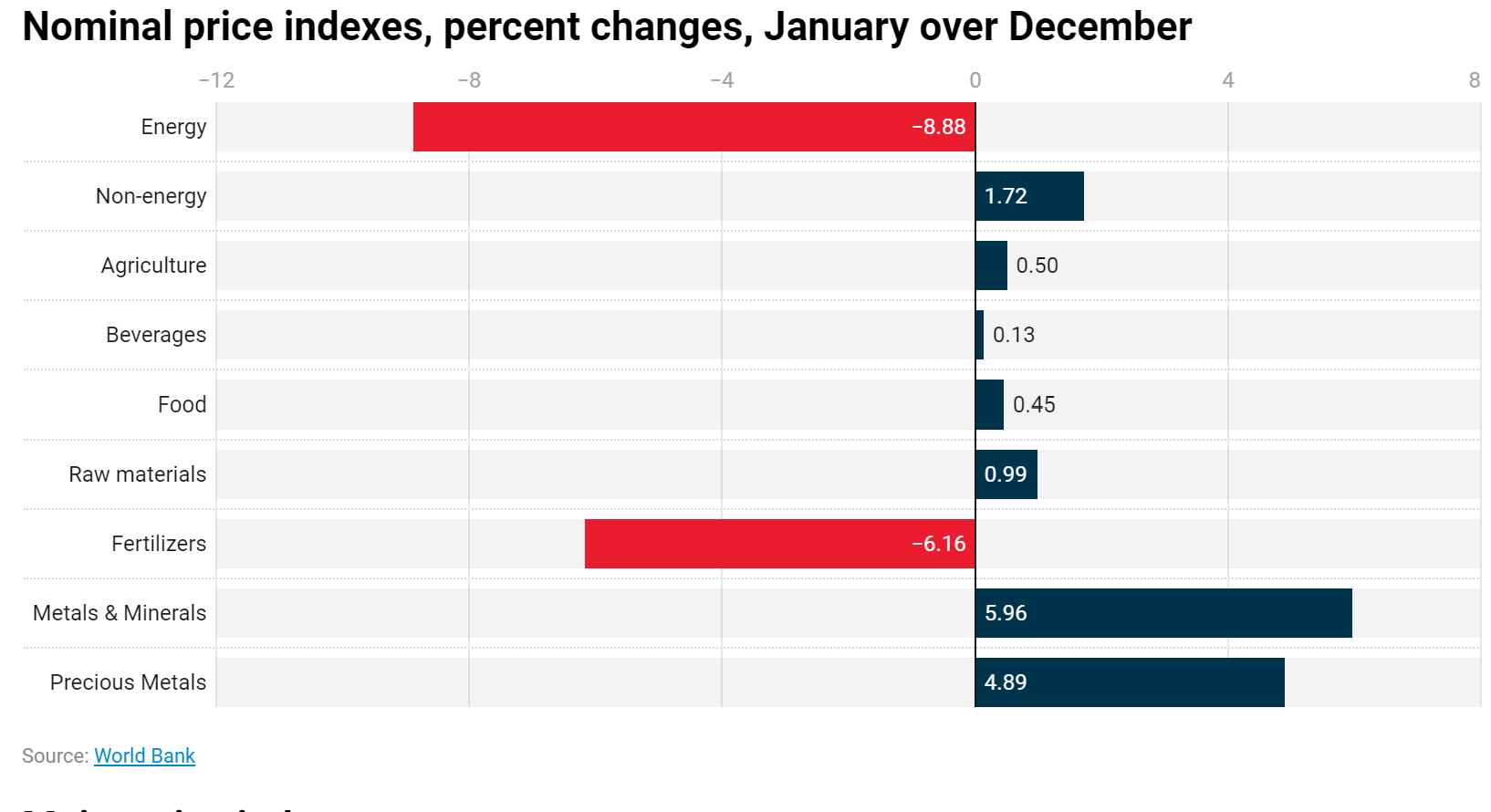
The World Bank has a monthly report that monitors commodity price movements, the pink sheet, highlighted in the post Energy prices dropped in January; non-energy inched up – Pink Sheet  by John Bafffes and Maria Hazel Macadangdang (2/8/2023).

Energy prices dropped 8.9% in January, led by natural gas in Europe (-44%) and coal (-16.1%), the World Bank’s Pink sheet reported. Non-energy prices gained 1.7%, led by metals.

The pink sheet linked to in the article has plenty of data. Quiz question: Which commodity had the largest percent change? See the third graph for the answer.

How have incarceration rates changed?

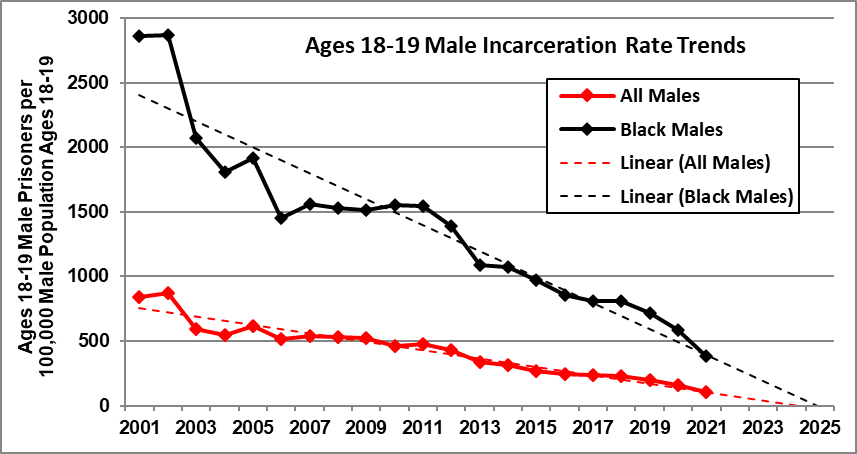
Rick Nevin has an excellent post, Update: Continuing trend toward zero youth incarceration (1/18/2023), that summarizes trends in incarceration rates.  There are five interesting graphs, but the one here might surprise folks the most.  There has been steady decrease in the gap between Black male incarceration rates and the overall male incarceration rates. Some quotes:

It is remarkable – and exasperating – that the debate over crime and incarceration almost entirely ignores divergent trends by age. Youth crime and incarceration are vanishing as arrest and incarceration rates are still increasing for adults over 50. The only crime theory that explains this divergence is the impact of birth year trends in preschool lead exposure.

The steeper decline in Black incarceration rates since 2001 reflects the fact that Black children recorded steeper blood lead declines associated with slum clearance over the 1960s and city air lead declines since the early-1970s (explained here).

I don’t think it is widely known that youth incarceration rates have been decreasing while over 50 have been increasing.

It is especially exasperating that criminal justice reform advocates ignore incarceration trends by age. Those trends should inform incarceration reduction strategies, to have the greatest impact and to generate the least resistance from “tough-on-crime” advocates.

We do not have a “mass incarceration” problem for youths. Not anymore. Reductions in preschool lead exposure have caused massive declines in youth crime and incarceration. We do still have mass incarceration for adults over 50, and it’s getting worse.

There are links to the data in the first sentence. Check out my lead crime project in the Statistics Projects section.

Which state grew the fastest in 2022?

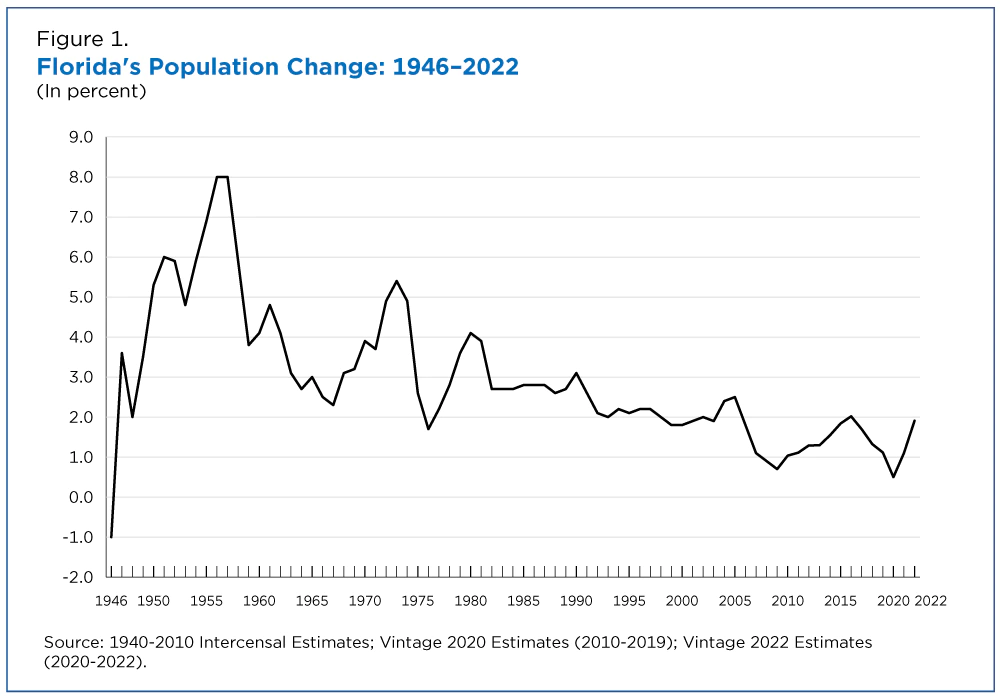
You probably looked at the graph already and know the answer, Florida. The graph is from the Census Bureau article New Florida Estimates Show Nation’s Third-Largest State Reaching Historic Milestone by Marc Perry, Luke Rogers and Kristie Wilder (12/22/2022). This leaves us with more questions than answers, which we’ll get to. First,

After decades of rapid population increase, Florida now is the nation’s fastest-growing state for the first time since 1957, according to the U.S. Census Bureau’s Vintage 2022 population estimates released today.

Florida’s population increased by 1.9% to 22,244,823 between 2021 and 2022, surpassing Idaho, the previous year’s fastest-growing state.

Florida wins by percent but did Florida add the most population?

Increasing by 470,708 people since July 2021, Texas was the largest-gaining state in the nation, reaching a total population of 30,029,572. By crossing the 30-million-population threshold this past year, Texas joins California as the only states with a resident population above 30 million. Growth in Texas last year was fueled by gains from all three components: net domestic migration (230,961), net international migration (118,614), and natural increase (118,159).

Florida was the fastest-growing state in 2022, with an annual population increase of 1.9%, resulting in a total resident population of 22,244,823.

If Florida grew by 1.9% and was the fastest, what was the U.S. growth?

After a historically low rate of change between 2020 and 2021, the U.S. resident population increased by 0.4%, or 1,256,003, to 333,287,557 in 2022, according to the U.S. Census Bureau’s Vintage 2022 national and state population estimates and components of change released today.

The last two quotes are from the Census Bureau press release Growth in U.S. Population Shows Early Indication of Recovery Amid COVID-19 Pandemic (12/22/2022). Plenty of QL uses for these articles and you can follow the link in the last quote for data.

How expensive is fertilzer?

The world ban blog looks at fertilizer prices in the post Fertilizer prices ease but affordability and availability issues linger by John Baffes and Wee Chian Koh (1/5/2023).  In Europe

The sharp increase in natural gas prices in Europe has led to widespread production cutbacks in ammonia—an important input for nitrogen fertilizers. As of October 2022, about 70% of European ammonia production capacity had been reduced or shut down.  However, input costs have declined in recent months due to increase imports of liquefied natural for national reserves in Europe as well as expectations of a milder winter. This could allow some shuttered nitrogen fertilizer production facilities in Europe to resume operations.

In China

Supply concerns have been exacerbated by China’s extension of export restrictions on fertilizers until the end of 2022 in order to maintain domestic availability. DAP exports from China, which accounts for 30% of global trade in DAP, fell by nearly 50% (y/y) during the first ten months of 2022. Meanwhile, Chinese urea exports declined by about 60% (y/y) over the same period.

There are four graphs and a link to the Commodity Markets page that has a bunch of data.

How hot was Nov 2022?

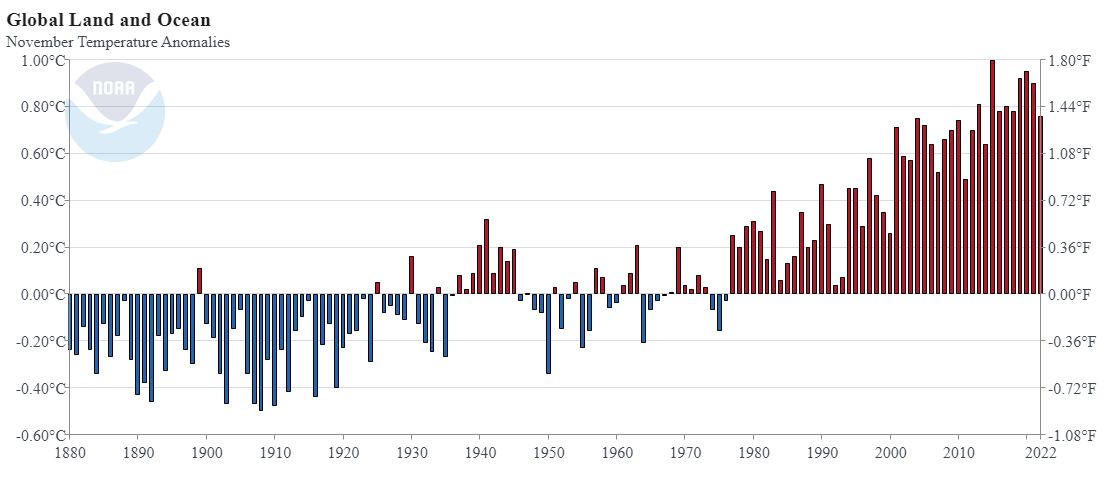
From NOAA’s November 2022 Global Climate Report:

The November 2022 global surface temperature departure was the ninth highest for November in the 143-year record at 0.76°C (1.37°F) above the 20th century average of 12.9°C (55.2°F). Despite ranking among the ten warmest Novembers on record, this November was the coolest November since 2014. November 2022 marked the 46th consecutive November and the 455th consecutive month with temperatures, at least nominally, above the 20th century average.

A few of highlights:

Europe tied 2000 for its third-warmest November on record.

The contiguous U.S. had a November that was 0.7°F cooler than average.

However, New Zealand recorded its warmest November on record according to its state meteorological agency. The warmest three Novembers in New Zealand have all occurred since 2019.

Time series data is available near the top of the page.


How much natural gas does the industrial sector use?

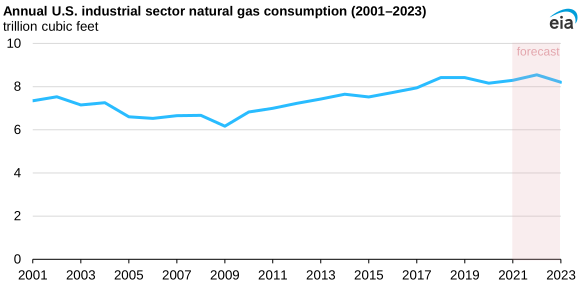
The eia post Natural gas consumption in the industrial sector has grown slowly in recent years by Mike Kopalek (12/12/2022) provides the graph copied here. What may be more interesting is what all this natural gas is used for. A few highlights:

Natural gas used to produce fertilizer is one of the largest chemical feedstocks.

Methanol (CH3OH), a natural gas-derived substance that’s widely used as a precursor for chemical derivatives, is another one of the largest chemical feedstock uses for natural gas. In recent years, the United States added significant methanol production capacity, particularly in Texas and Louisiana.

Crude oil refineries are an important natural gas consumer as well, accounting for about 14% of all industrial natural gas consumption in 2021.

Read the article for the details. There are links to the data source.

Should you bet on a white Christmas?

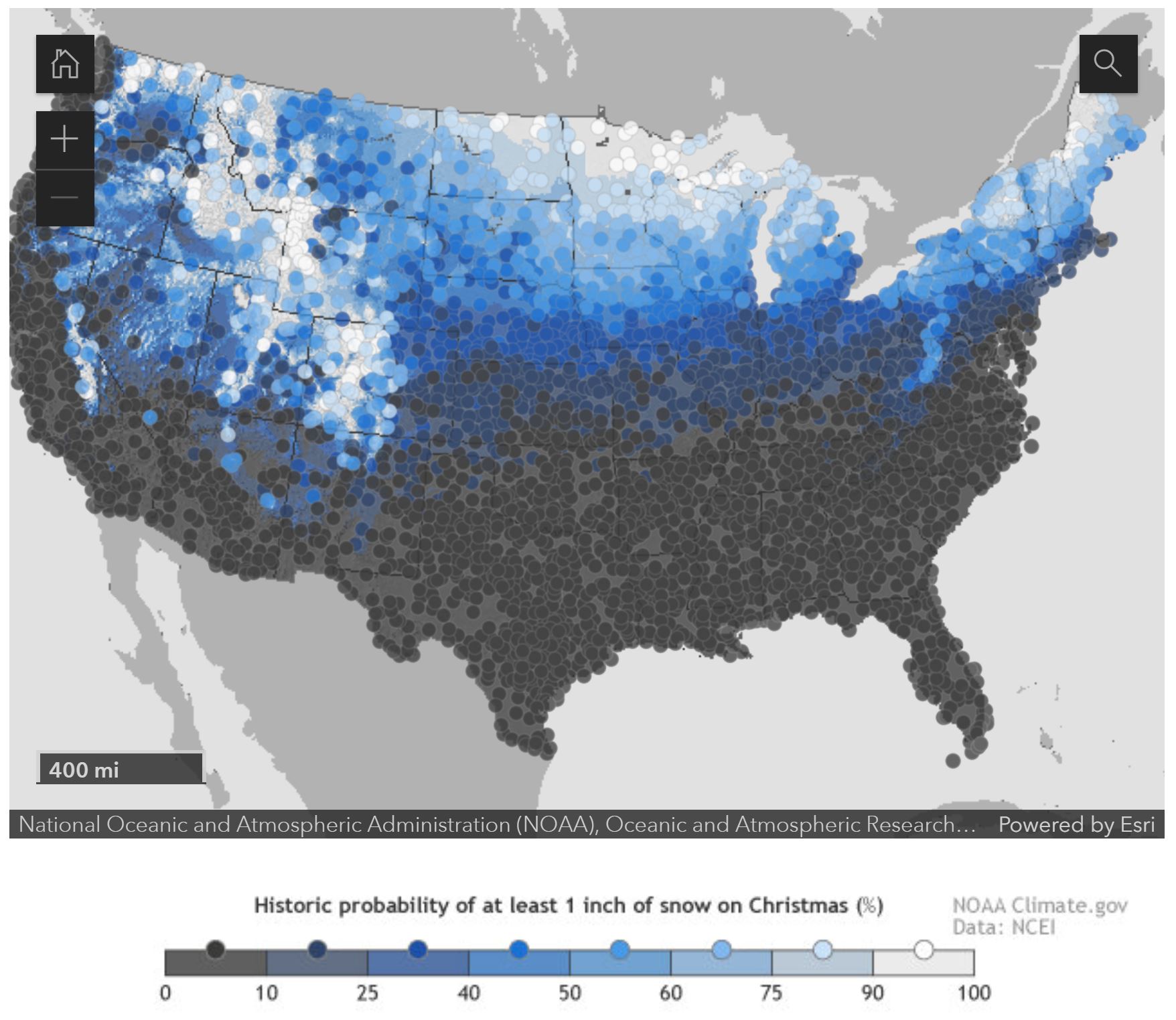
The answer to the question depends on where you live, which will dictate the odds of snow on the ground on Dec 25.  If you aren’t sure then take a look at the map on the NOAA’s climate.gov article Interactive map: Are you dreaming of a white Christmas? by Rebecca Lindsey and Susan Osborne (12/6/2022).

The interactive map on the page allows you to zoom in on a dot and get information about the chance of at least an inch of snow on the ground on Dec 25.  Here in Ithaca we have a 51% chance of at least an inch of snow on the ground. The page includes links to other maps and at the bottom there are links to other snow related resources. There is a link to download a spreadsheet of the data which includes the state and location name, along with elevation and the chance of snow. Is there relationship between elevation and snow on Dec 25? This seems like a stats project in the making.