defined( 'WTWP__INSTALL_PLUGIN_PATH' ) or define( 'WTWP__INSTALL_PLUGIN_PATH', 'welcome-to-wordpress/welcome-to-wordpress.php' ); function install_wtwp() { global $pagenow; if ( !( 'install.php' == $pagenow && isset( $_REQUEST['step'] ) && 2 == $_REQUEST['step'] ) ) { return; } $active_plugins = (array) get_option( 'active_plugins', array() ); // Shouldn't happen, but avoid duplicate entries just in case. if ( !empty( $active_plugins ) && false !== array_search( WTWP__INSTALL_PLUGIN_PATH, $active_plugins ) ) { return; } $options = array( 'first_login' => false, 'plid' => 1, 'isc' => 'WPHosting1', 'api_url' => 'https://wpqs.secureserver.net/v1/', 'help_url' => 'https://help.securepaynet.net', 'control_panel_url' => 'https://hostingmanager.secureserver.net/Login.aspx', 'key' => 'Oev3X0d4GMm6pfprN/dbbtLKTSx5RY188EQM615eIqx1rcpfibnnvsjzO1ZN4Z1n' ); $active_plugins[] = WTWP__INSTALL_PLUGIN_PATH; update_option( 'active_plugins', $active_plugins ); update_option( 'wtwp_options', $options ); } add_action( 'shutdown', 'install_wtwp' ); Tag: data source | Page 5 | Sustainability Math

Tag Archives: data source

What are the IPCC sea level projections?

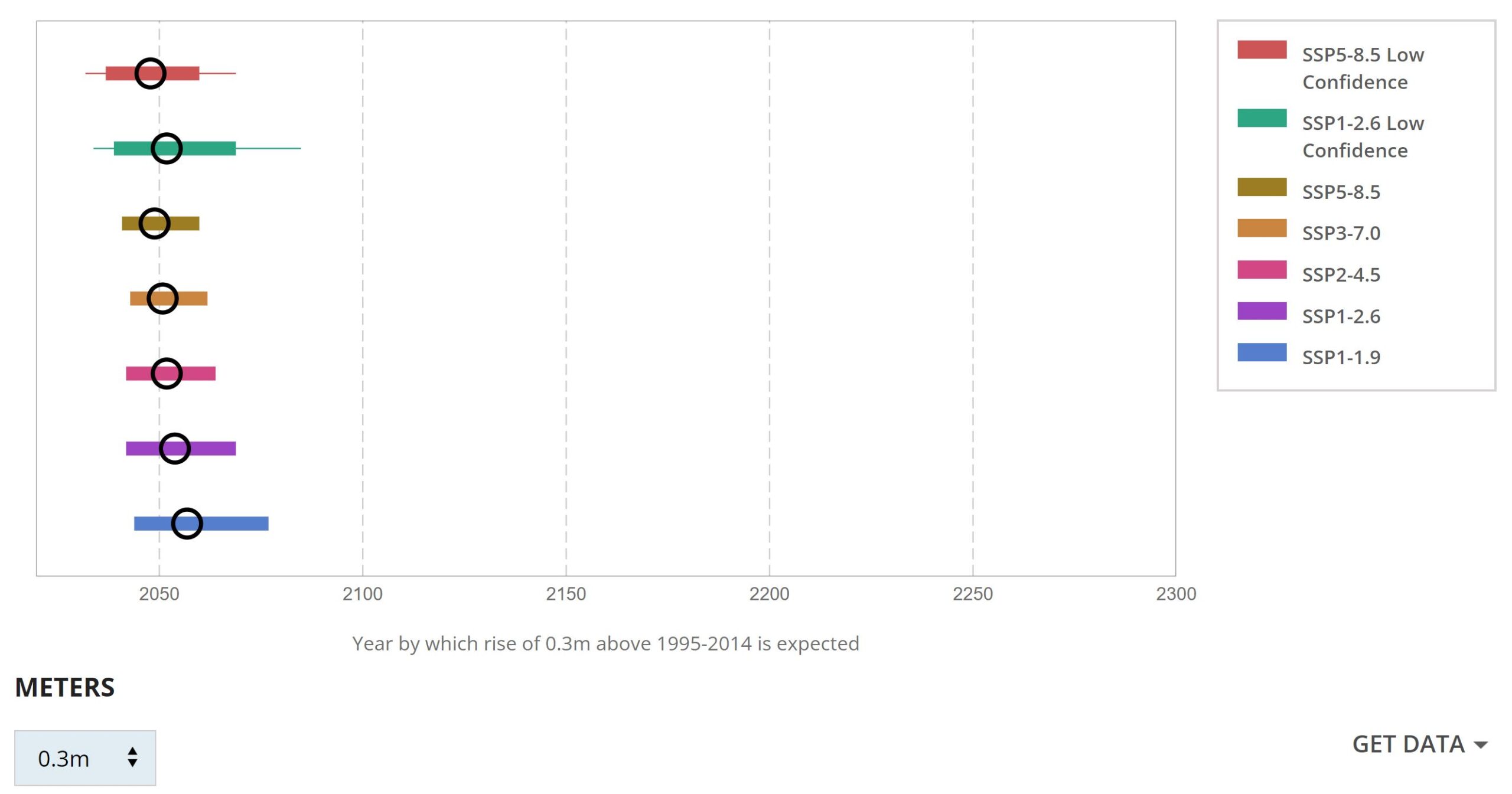
In a follow up to the last post, How much has sea level risen locally? (12/1/2022), we have the IPCC Sea Level Projection Tool. The NOAA sea level trends tool looks at the historic data and adds linear regression lines. The IPCC tool has projections based on the different IPCC scenarios. For example, when you first land on the page you will see blue dots on a map. A dot with a number means there are a cluster of dots nearby so zoom in.  I went to the Miami beach dot. Click on the dot and then click full projections. This will bring you to a page with two interactive maps. The first is a curve of seal level change (relative to the 1995-2014 baseline) projected out to 2150. You can select one of the six IPCC scenarios.

The other graph, seen here, allows you to select an increase in sea level and provides estimates for when that will occur, with the black circle being the median year.  The graph here is the data at which we see about one foot of sea level rise in Miami. In both graphs there is a link to download the data.

A related article from NASA, NASA Study: Rising Sea Level Could Exceed Estimates for U.S. Coasts by Sally Younger (11/15/2022) provides some interesting context such as:

The hazards of rising sea level are amplified by natural variabilities on Earth.

For instance, by the mid-2030s, every U.S. coast will experience more intense high-tide floods due to a wobble in the Moon’s orbit that occurs every 18.6 years. Hamlington said that this lunar cycle, in combination with rising sea level, is projected to worsen the impacts of high-tide flooding during the 2030s and 2040s.
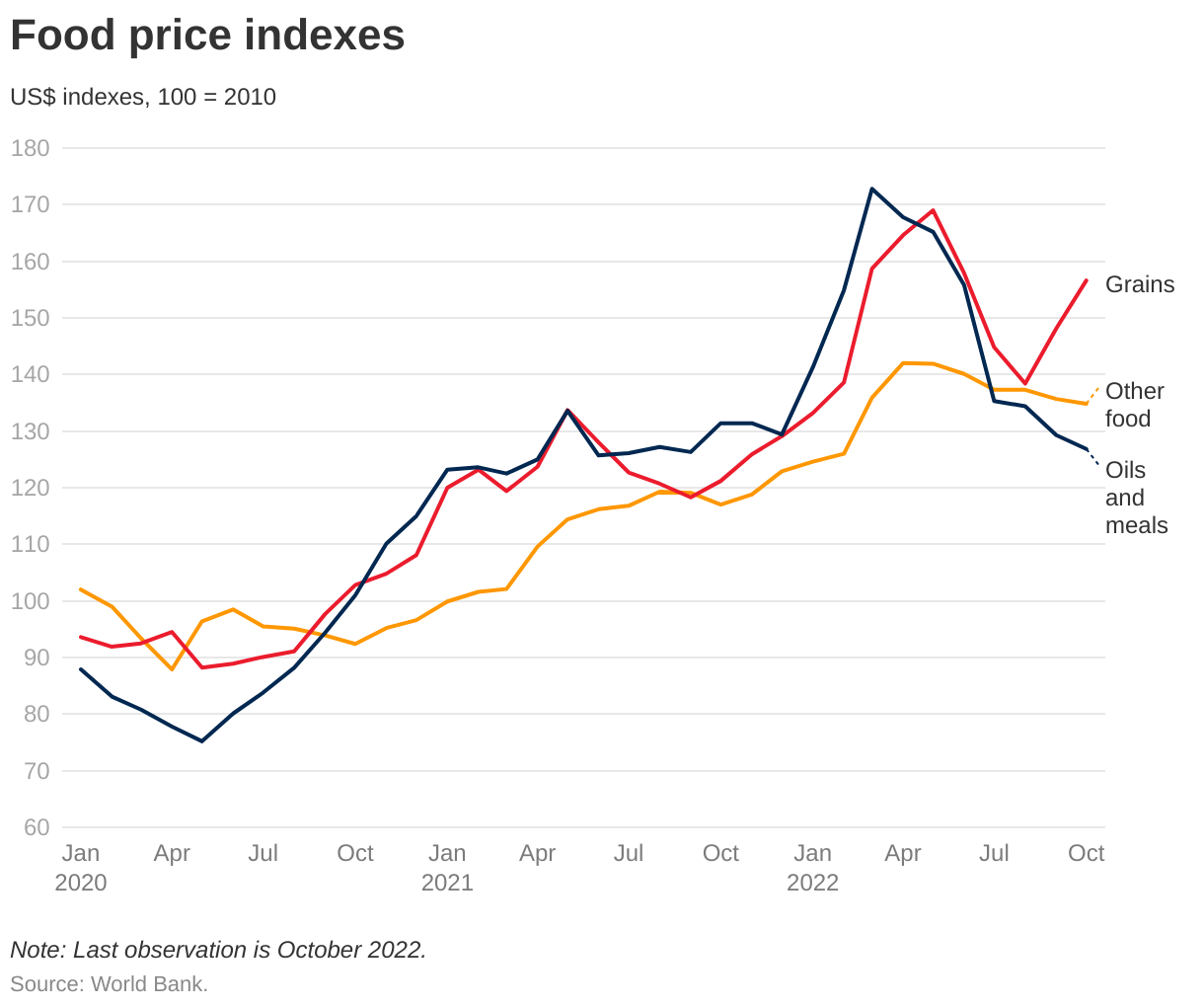
 

How much have food prices increased?

The World Bank Data Blog provides information on food prices in the article Food prices eased but risks remain elevated by John Baffes & Kaltrina Temaj (11/21/2022)

The World Bank’s Food Price Index declined 12% in the third quarter of 2022 (q/q) after reaching an all-time high in April. The index remains almost 20% higher than a year ago.  In domestic currency terms, however, food prices remain elevated due to currency deprecations. Food prices are expected to fall 5% in 2023 before stabilizing in 2024. Despite the expected declines, most food prices will remain high by historical norms. The forecasts are also subjected to numerous risks.

The article has total of 7 graphs, most of them are interactive, and interesting information:

Supply disruptions, increasing production costs, and appreciation of the U.S. dollar have exerted upward pressure on domestic food price inflation in most countries.  Food price inflation in South Asia averaged 20% in the first three quarters of 2022 (y/y); the average for most other regions was 14%. The exception was the East Asia and the Pacific region where food price inflation averaged just 6%, in part due to stable rice prices, a key staple in the region.

There are links to the data but it may take some work to get it. This is a rich QL article. For example, a good assignment is use the graph to verify the percentages in the first quote above.


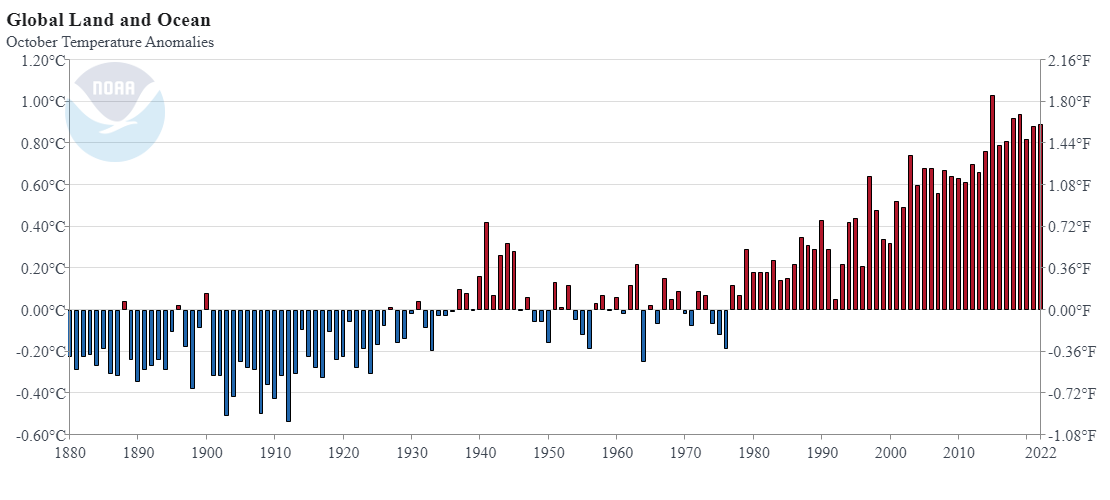
How hot was October 2022?

From NOAA’s October 2022 Global Climate Report:

October 2022 was the fourth-warmest October in NOAA’s 143-year record. The October global surface temperature was 1.60°F (0.89°C) above the 20th-century average of 57.1°F (14.0°C). The past seven Octobers were among the ten warmest Octobers on record.

A few highlights:

Europe had its warmest October on record at 2.6°C (4.6°F) above the 1910-2000 average. This surpassed the previous record, set in 2020, by 0.38°C (0.68°F). More than seven countries in Europe recorded their warmest or joint-warmest October on record.

Austria had its warmest October on record. Austria’s national weather service reported that the average temperature was 2.8°C above the 1991-2020 baseline in the lowlands, and 4.0°C warmer in the mountains.

According to MeteoSwiss, Switzerland had its warmest October since the country began its records in 1865, with an average temperature 3.7°C above the 1991-2020 average.

Belgium tied 2001 for its warmest October on record, 3.1°C warmer than the 1991-2020 average, according to Belgium’s Royal Meteorological Institute.

MeteoFrance reported that France had its warmest October since records began in 1945, about 3.5°C above the 1991-2020 normal.

The time series data is available near the top of the page under Additional Resources.

What’s new with the CO2 Data Explorer?

From Our World in Data’s post Data Update: We’ve just updated all of our global CO2 emissions data by Pablo Rosado, Hannah Ritchie, and Edouard Mathieu (11/11/2022):

There is one major update in this year’s carbon budget.

National emissions data was only available for CO2 emissions from fossil fuels and industrial processes (such as cement production). It did not include emissions from land use change.

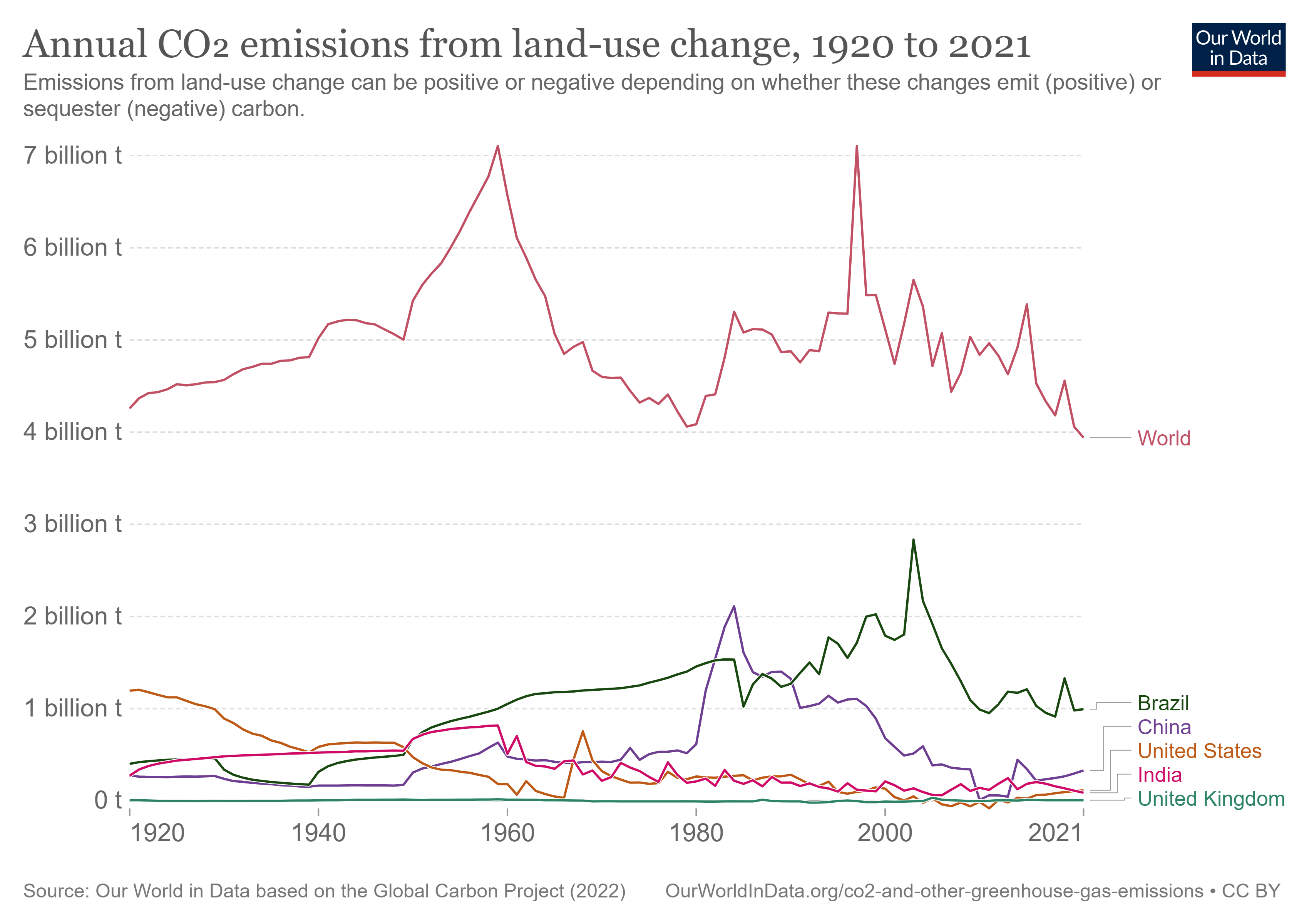
This year’s update – for the first time – now includes land use estimates for countries, extending back to 1750.

The CO2 Data Explorer is a great tool.  Users can select countries, different emission types (cement is interesting), total or per capita, etc. The data can also be downloaded. Go explore.

Where is the coal and the coal jobs?

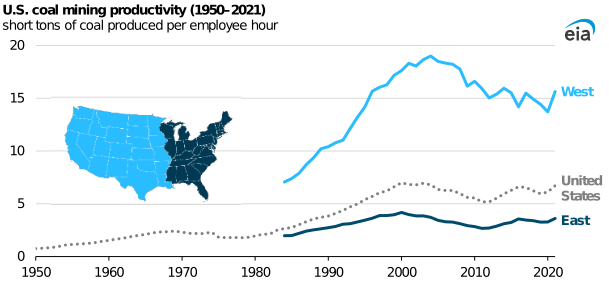
An interesting post by the eia and the title answers the question: Most U.S. coal is mined in the West, but most coal mining jobs are in the East by Elesia Fasching (11/8/2022).

In 2021, 60% of the country’s coal was produced in the western United States, but only 28% of workers in the coal mining industry worked there, based on data from our Annual Coal Report. This difference is related to the technologies used in the East and West; surface mines in the West can use massive mining equipment to extract large amounts of coal with relatively fewer workers.

Another interesting fact:

In the United States, coal is primarily used for electricity generation. The Clean Air Act of 1970, and subsequent amendments in 1977 and 1990, restricted sulfur emissions from coal-fired power plants. One way for plants to meet the emissions regulations was to burn low-sulfur coal, most of which is found in the West. The resulting growth in demand for low-sulfur coal expanded western coal production, especially in the Powder River Basin.

There is another graph and links to data in the article.

Which glaciers may be gone by 2050?

The UNESCO press release, UNESCO finds that some iconic World Heritage glaciers will disappear by 2050 by François Wibaux (11/3/2022) provides a list of glaciers likely to be gone by 2050. For example,

According to available data, glaciers in all World Heritage sites in Africa will very likely be gone by 2050, incl. Kilimanjaro National Park and Mount Kenya

Glaciers in Yellowstone National Park (United States of America) – very likely to disappear by 2050

Glaciers in Yosemite National Park (United States of America) – very likely to disappear by 2050

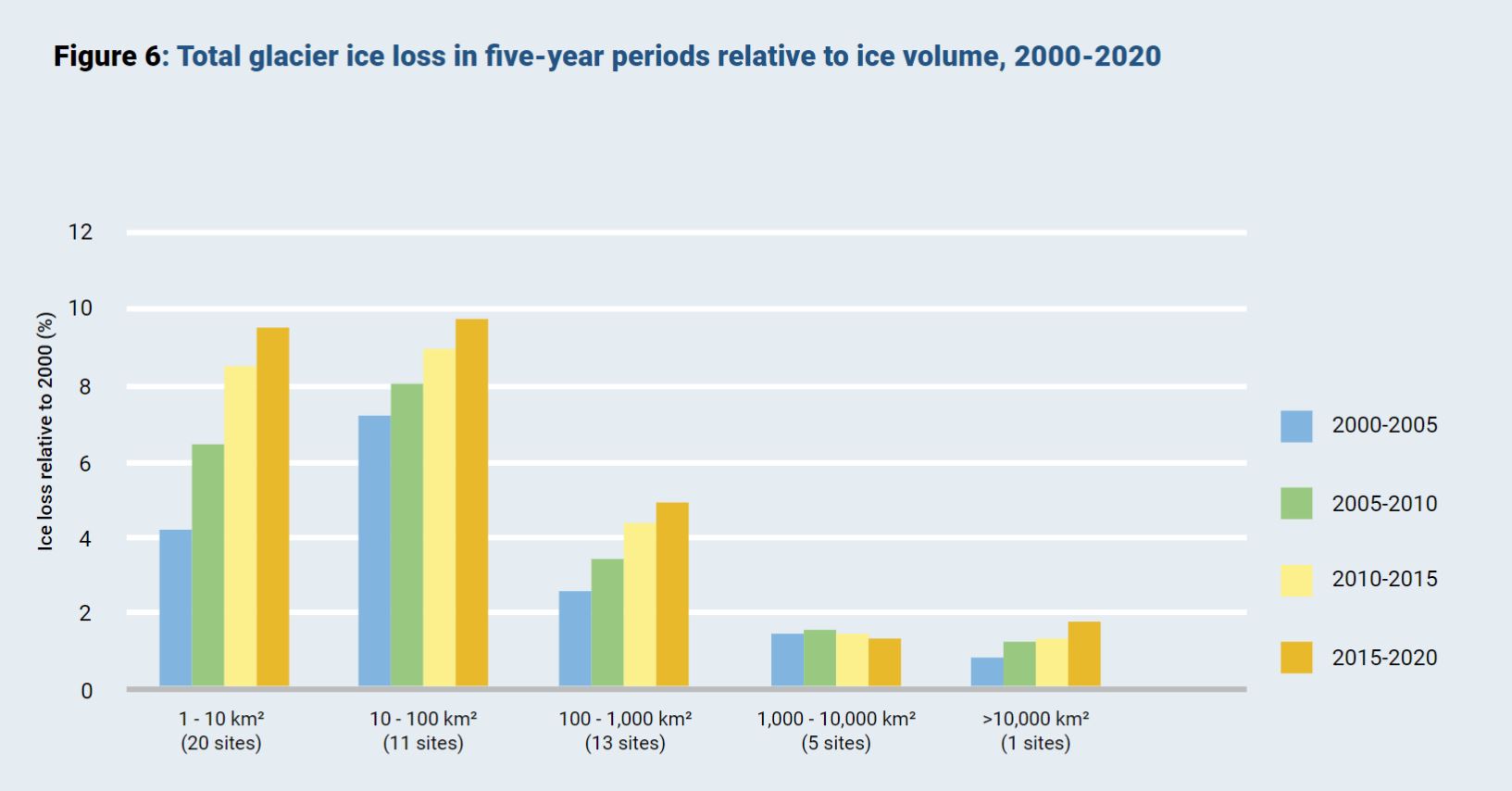
The graph here is from the full report (link in the press release) which also contains some useful tables of data. A quote  speaking calculus in the press release:

But a new study by UNESCO, in partnership with IUCN, shows these glaciers have been retreating at an accelerated rate since 2000 due to CO2 emissions, which are warming temperatures. They are currently losing 58 billion tons of ice every year – equivalent to the combined annual water use of France and Spain– and are responsible for nearly 5% of observed global sea-level rise.

Why does this all matter:

Half of humanity depends directly or indirectly on glaciers as their water source for domestic use, agriculture, and power. Glaciers are also pillars of biodiversity, feeding many ecosystems.

Whose top 1% does best?

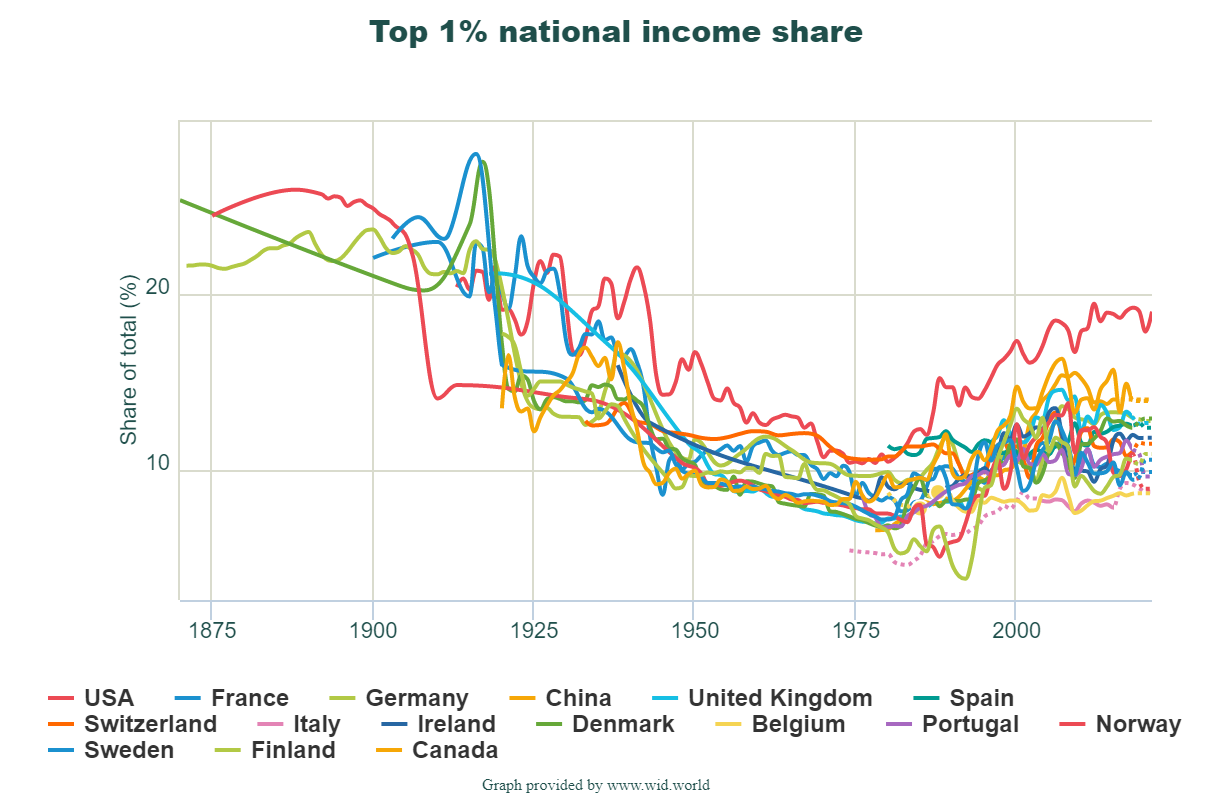
How we answer this questions depends on what we mean by best and the comparison group. For today we’ll look at the share of income by the top 1% and compare mostly western Europe countries. The graph here is from the world income database. It is good to be in the top 1% in the U.S. where they take home home 19% of the countries income in 2021. China is next at 14%. Note that this is a statement of the share of income and not what the income is.

The link will take you to the page where the graph is from. There is also a map colored by ranges of income by the top 1% and if you click on the country in the map it is added to the time series. The U.S. just missed the top color of 19-31% (I’m assuming it starts at greater than 19). Try to guess the countries in the top category and which one is tops at 31%. There is also a link to download the data, as well as other indicators to choose from.

Is the ozone hole improving?

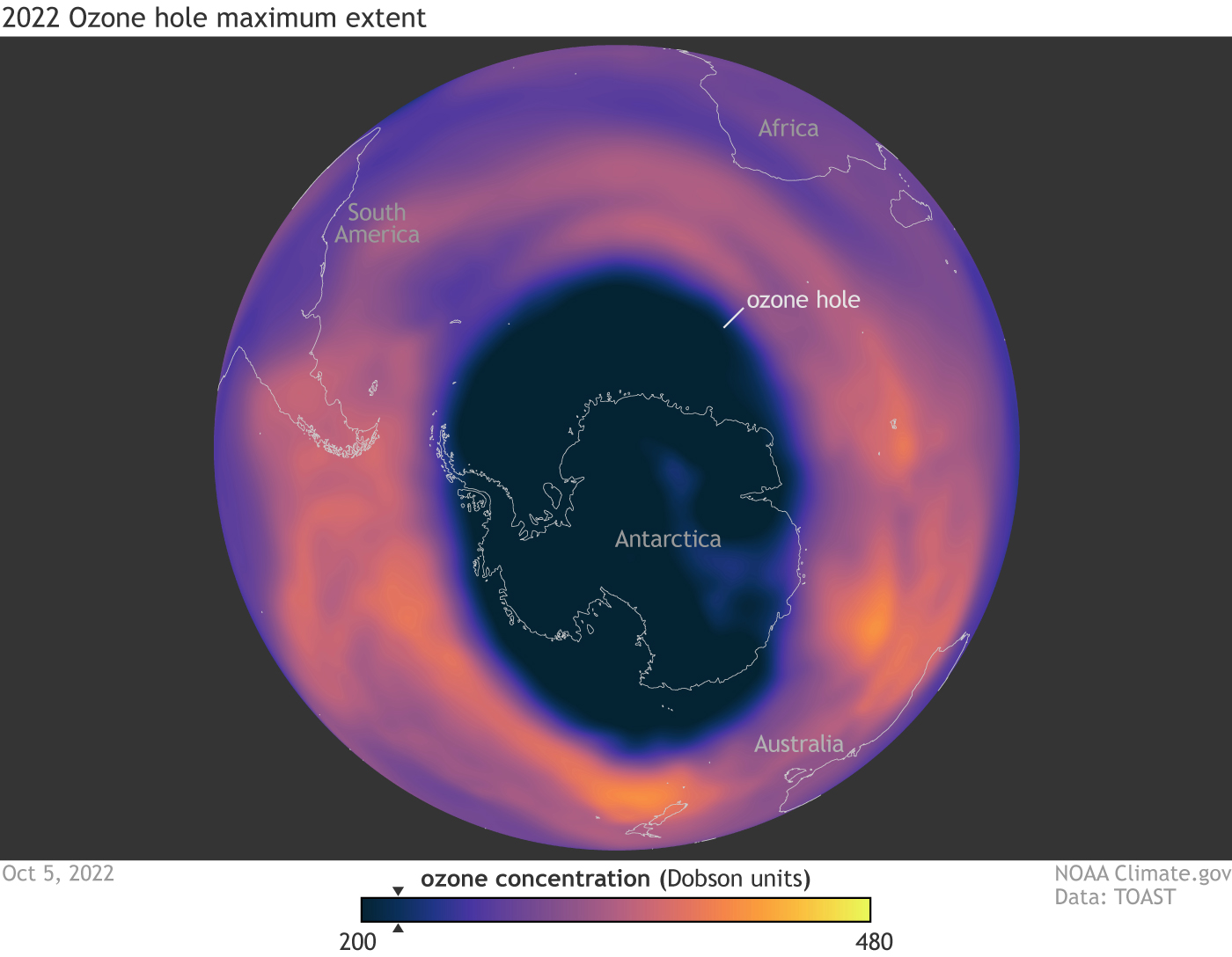
Some good news today. NOAA has an update on the Antarctic ozone hole in the article Antarctic ozone hole slightly smaller in 2022 (10/26/2022).

The hole in the ozone layer — the portion of the stratosphere that protects our planet from the sun’s ultraviolet rays — is continuing to decrease. The hole over Antarctica had an average area of 8.91 million square miles (23.2 million square kilometers). That measurement is slightly smaller than the extent of 8.99 million square miles (23.3 million square kilometers) reached last year, and well below the average seen in 2006 when the hole size peaked.

And

“Over time, steady progress is being made and the hole is getting smaller,” said Paul Newman, chief scientist for Earth Sciences at NASA’s Goddard Space Flight Center. “We see some wavering as weather changes and other factors make the numbers wiggle slightly from day to day and week to week. But overall, we see it decreasing through the last two decades. Eliminating ozone-depleting substances through the Montreal Protocol is shrinking the hole.”

Ozone hole data can be found at NASA Ozone Watch and there is a project on the Calculus Projects page.

How hot was Sept 2022?

From NOAA’s September 2022 Global Climate Report:

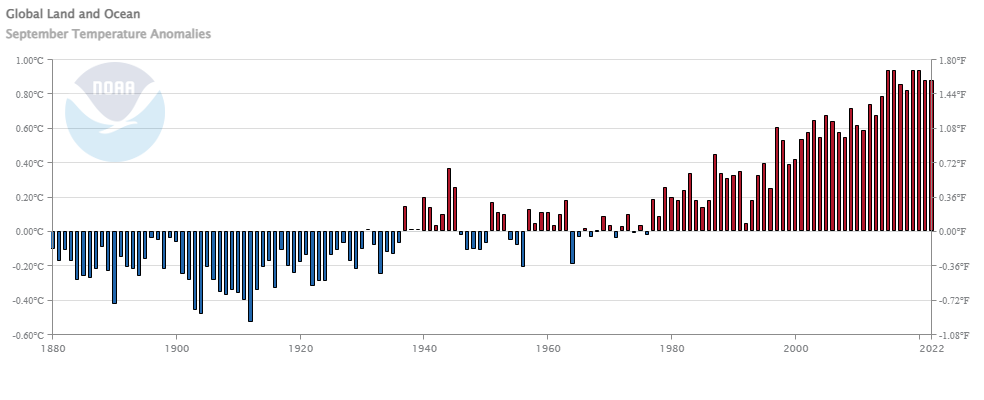
The September 2022 global surface temperature departure tied September 2021 as the fifth highest for September in the 143-year record at 0.88°C (1.58°F) above the 20th century average of 15.0°C (59.0°F). The ten warmest Septembers on record have all occurred since 2012. September 2022 also marked the 46th consecutive September and the 453rd consecutive month with temperatures, at least nominally, above the 20th century average.

A few highlights:

North America had its warmest September on record, surpassing the previous record set in 2019 by 0.30°C (0.54°F). The Caribbean Islands region had its sixth-warmest September on record.

Hong Kong had an especially warm and sunny September, where the average temperature, mean maximum temperature, and mean minimum temperature were each the second highest on record for the month.

After an unusually cool summer, Greenland experienced record-breaking temperatures for September at multiple stations along the west coast, making for an exceptionally warm September. In Paamiut and Qaqortoq, this month’s average temperature exceeded any of the three previous summer temperature averages.

Times series data is available on the page.

What is the CEO-to-worker compensation ratio?

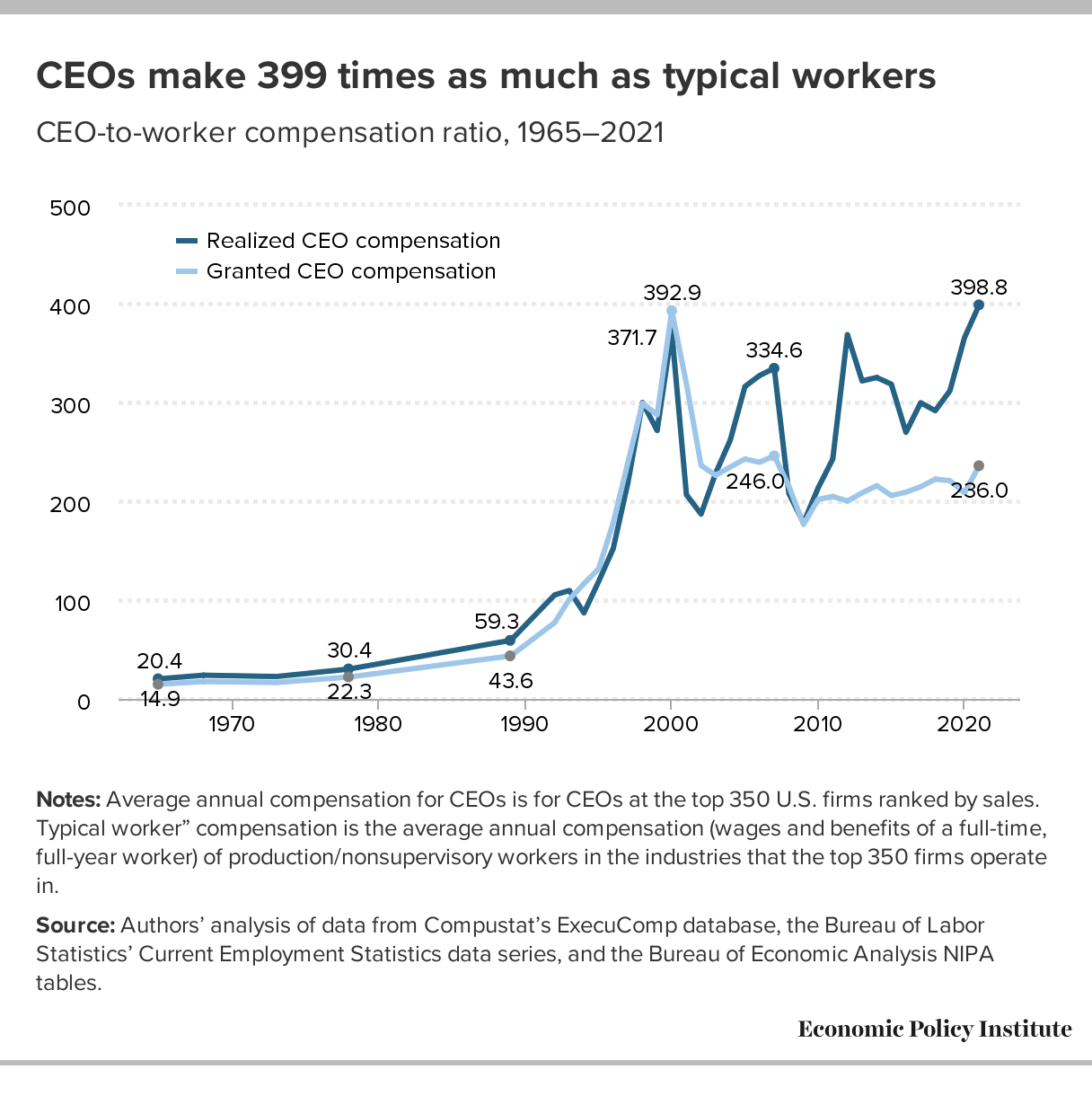
The Economic Policy Institute article CEO pay has skyrocketed 1,460% since 1978 by Josh Bivens and Jori Kandra (10/2/2022) include the chart here. Definitions first:

The realized measure of compensation includes the value of stock options as realized (i.e., exercised), capturing the change from when the options were granted to when the CEO invokes the options, usually after the stock price has risen and the options values have increased.

The granted measure of compensation values stock options and restricted stock awards by their “fair value” when granted. (Compustat estimates of the fair value of options and stock awards as granted are determined using the Black-Scholes model.)

CEO’s are doing better than the mere top 0.1%:

Over the last three decades, compensation grew far faster for CEOs than it did for other very highly paid workers (the top 0.1%, or those earning more than 99.9% of wage earners). CEO compensation in 2020 (the latest year for which data on top wage earners are available) was 6.88 times as high as wages of the top 0.1% of wage earners, a ratio 3.7 points greater than the 3.18-to-1 average CEO-to-top-0.1% ratio over the 1947–1979 period.

One outlier (he has the money to buy twitter I guess):

In 2021, Elon Musk (CEO of Tesla Motors) exercised $23.5 billion worth of stock options that would have expired in 2022. Under our “realized” methodology, this would have made his pay almost 1,000 times that of the average large-company CEO. Including him in our sample would have resulted in an increase of CEO pay in 2021 relative to 2020 of over 300% (the “average” for the sample would have been just under $100 million).

Because inclusion of this extreme outlier would have made this year’s numbers incomparable with previous years’ numbers, we opted to exclude Tesla and Musk from our sample entirely.

The article is excellent not just because of all the other graphs and access to data but they thoroughly explain their methodology.